ArtoEast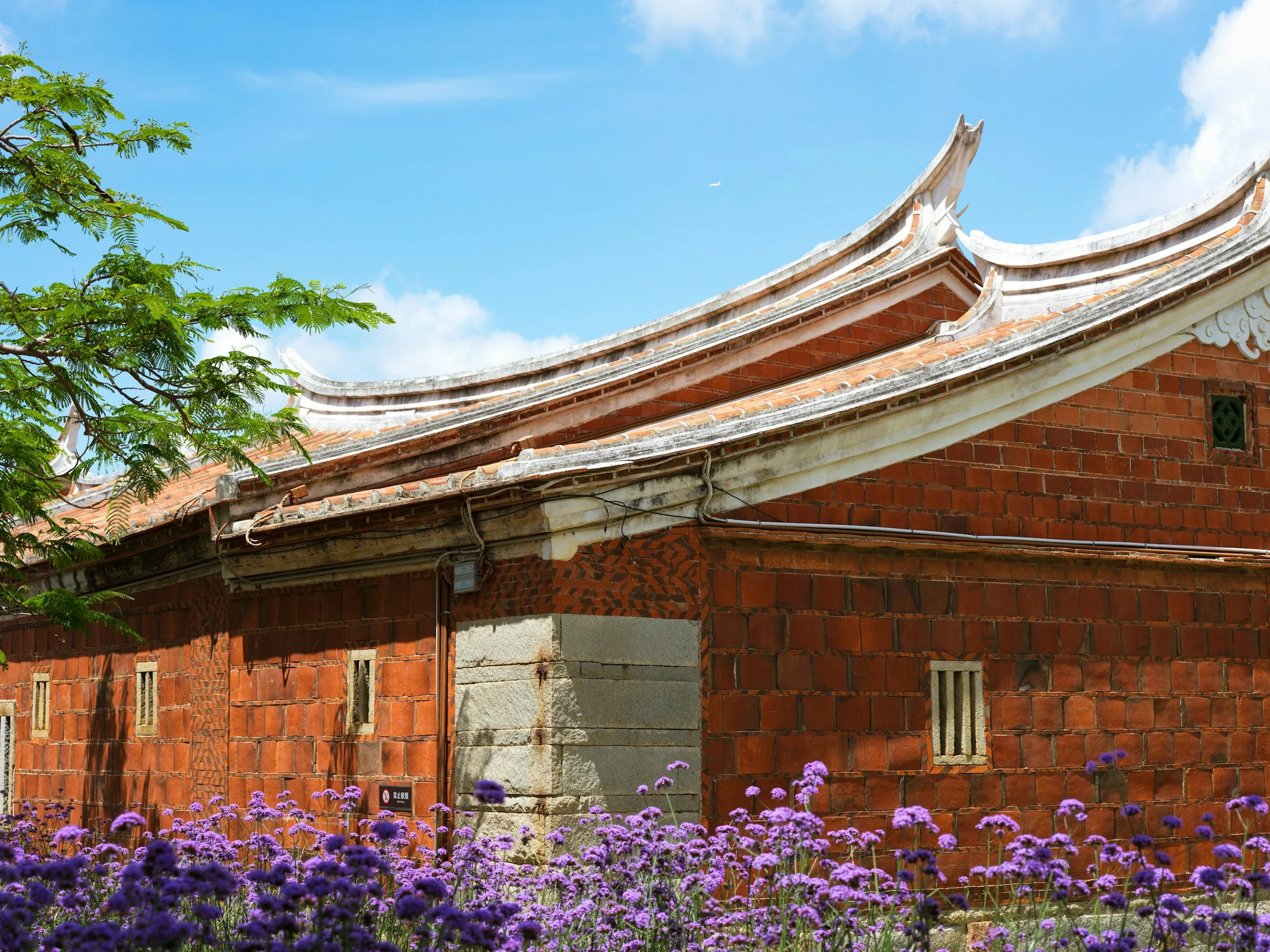
Quanzhou stones, the port that talked to the world
A slow walk through Liwan's lanes, where Song-era Zaitun left its strange edges in stone, ink, and the salt smell of the Min estuary.
We arrive at the Qingjing Mosque on Tumen Street a little after seven in the morning, when the light is still grey and the vendors at the corner are stacking trays of mianxian, the thin Fujianese noodles, into bamboo steamers. The mosque's outer wall is granite, cut in the year 1009, and the stone has gone the colour of weak tea. A caretaker named Mr. Ding unlocks the side gate. He speaks Min Nan with us, then switches to Mandarin when he sees our notebooks, and points at the keel-arch portal: Syrian in inspiration, he says, but carved by Quanzhou masons who had never been to Damascus. The arch leans slightly. Nobody has corrected it in a thousand years.
Inside, the prayer hall has no roof. A typhoon took it in the Ming and the community never rebuilt it, choosing instead to keep the open sky above the mihrab. We sit on the worn flagstones for a while. Mr. Ding tells us his family name, Ding, descends from a Persian merchant who settled in the south quarter sometime under the Yuan, married a local woman, and converted his children's names into Chinese characters that approximate the original Arabic. There are still several thousand Dings in the surrounding villages. They eat with chopsticks, speak Min Nan, and bury their dead facing west.
Marco Polo, who passed through in the 1290s, called the city Zaitun, from the Arabic for olive, and wrote that it was one of the two greatest ports in the world. The other was Alexandria. It is hard, walking the narrow lanes of Liwan district now, to square that scale with the quiet, but the stones keep insisting. We attend to a fragment of an Arab tombstone embedded sideways in a wall on Tongzheng Alley, its kufic script half-eroded, reused as ordinary masonry by someone who had stopped reading Arabic generations earlier.
We walk north to Kaiyuan Temple, founded in 686, and sit in the courtyard with the two stone pagodas. The cicadas have started. A volunteer guide, Lin Suzhen, a retired schoolteacher, takes us behind the main hall to a pair of pillars that hold up the rear gallery. She wants us to look at the carvings: Vishnu reclining on the serpent Ananta, Narasimha tearing Hiranyakashipu, scenes from the Bhagavata Purana cut into Fujianese granite. They came, she says, from a Tamil Hindu temple that stood in Quanzhou during the Yuan, dismantled in the Ming, its stones absorbed into the Buddhist monastery the way a tide pool absorbs a smaller shell.
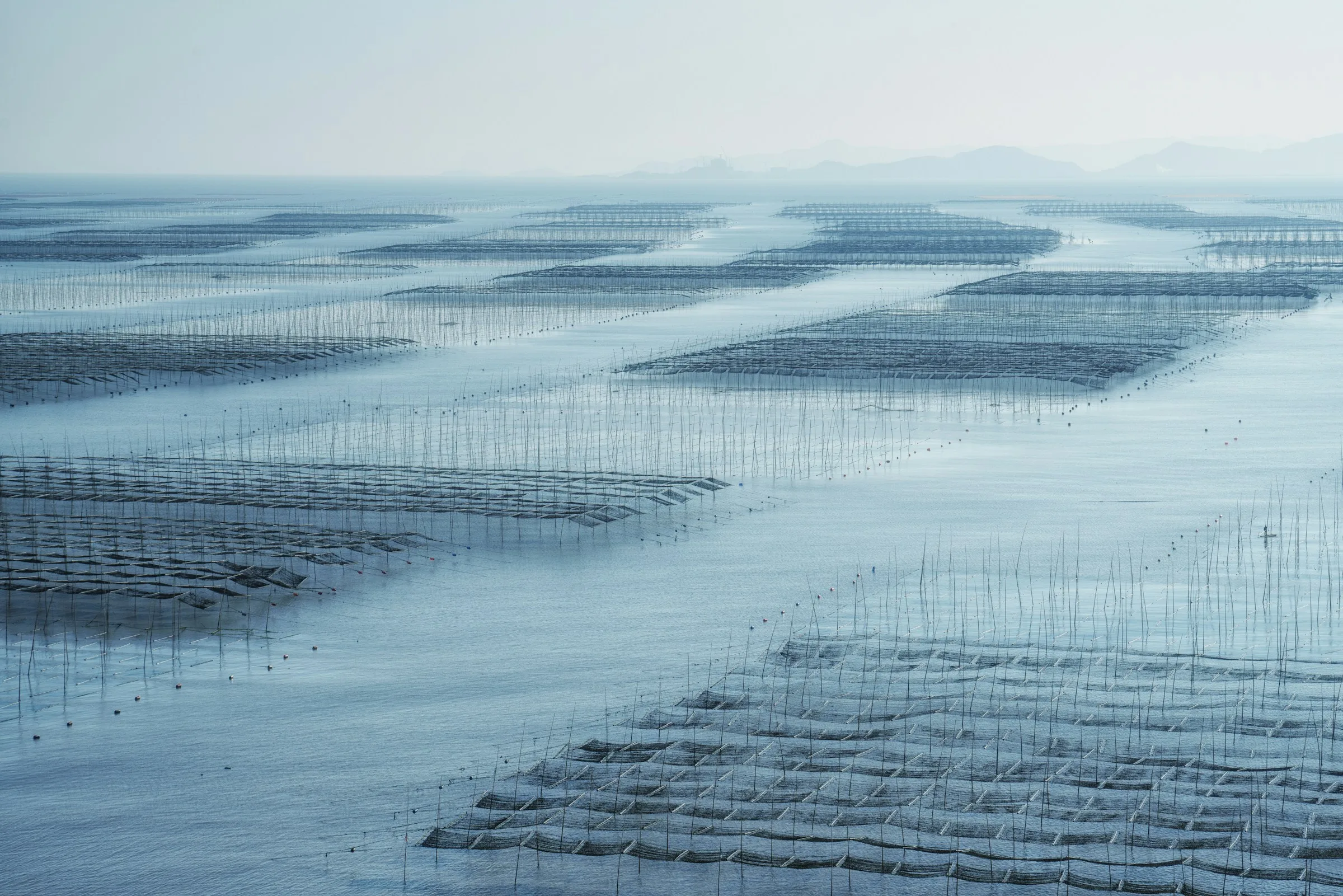
Lin Suzhen has been studying these pillars for twenty-two years. She corresponded for a decade with an epigrapher in Chennai about the iconography. She shows us her notebook: small, square handwriting, columns of Tamil transliteration on the left, Min Nan glosses on the right. Outside the temple, a woman is selling peeled water chestnuts in plastic bags. The Min River is half a kilometre south. The estuary smells, when the wind turns, of brackish mud, diesel, and something faintly sweet that we cannot name, maybe the longan orchards inland.
“A port is not a building but a habit, and Quanzhou's habit was to let strangers carve their gods into local granite.”
In the afternoon we sit with Professor Chen Dasheng at his apartment near Wenling Road. He is in his eighties now, a historian who has spent his career on the Persian and Arab families of the south quarter, the so-called Fan Fang where foreign merchants were permitted to live, worship, and bury their dead under Song administration. He brings out rubbings of inscriptions, some from tombstones found face-down in rice paddies in the 1950s, others from a Manichaean shrine on Huabiao Hill where the last followers of Mani in China kept a granite Buddha-shaped figure of their prophet into the seventeenth century. He pours us oolong from Anxi, the leaves opening slowly in the small cups.
He says the question that occupies him is not how the foreigners came, which is easy, the monsoon brought them, but how they stayed. A port is not a building but a habit, and Quanzhou's habit was to let strangers carve their gods into local granite. The habit broke, he says, in the late Yuan, when the Persian garrison rebelled and the Ming reprisals were severe. After that the city turned inward. The harbour silted. The trade moved to Yuegang and later to Xiamen. The mosques stopped being built. The Hindu temple was quarried for its stones.
The next morning we take a taxi out to Shihu, the old outer harbour, where the customs stones still stand at the water's edge. They are unmarked, blunt, about the height of a person. Ships measured their draught against them before entering the inner channel. We walk among them with a young archaeologist, Wu Jiamin, who is documenting the 2021 UNESCO inscription sites. Twenty-two of them across the city. She has the list on her phone. The Liusheng Pagoda, the Jiuri Mountain wind-prayer inscriptions, the bridge at Luoyang, the kiln sites at Cizao where the celadon for Southeast Asian markets was fired.
At the Quanzhou Maritime Museum we attend to a case of pottery fragments dredged from the bay: blue-and-white shards bound for Hormuz, celadon for Sumatra, a Longquan bowl with an Arabic phrase scratched into its foot rim by someone who wanted to mark ownership. Wu Jiamin says the most moving objects to her are the unfinished ones, the kiln rejects, because they prove the city was making for the world and not just trading what it had. A bowl with a slumped wall is still a bowl that was meant to cross an ocean.
We walk back to the old town in the evening. The lanes around Zhongshan Road have been tidied for the UNESCO listing, the shopfronts repainted in approved colours, the wires buried. It is handsome and slightly muted. Mr. Ding had warned us about this in the morning. He had said the danger is not that the stones will be lost but that they will be explained too well, with bilingual placards, until the strangeness goes out of them and they become items in a catalogue. The Hindu pillar at Kaiyuan is most powerful when you stumble on it behind the hall and have to ask what it is doing there.
We stop for dinner at a small place near the Confucian temple. Oyster omelette, sweet potato greens, a clay pot of duck with ginger. The owner's grandfather, she tells us, was a stevedore at the old wharf before it closed. She does not know exactly when it closed. Sometime before the war. The Min Nan she speaks has a few words in it, she thinks, that are not Chinese, words for ropes and knots, that her grandfather used and she half-remembers. She cannot give us examples. They surface, she says, only when she is tired.
Walking back to the guesthouse, we pass the mosque again. The granite wall is cool to the touch. A cat is sleeping on the threshold. Somewhere upriver a boat horn sounds, low and long, and the sound carries in the still air the way it must have carried in 1290, when this was the second port in the world and the lanes were full of languages nobody here speaks anymore. The stones are still here. Tomorrow we will sit with Lin Suzhen again and read her notebook more slowly.
— ArtoEast
Photography by lastmayday via Unsplash.
We design residencies, faculty-led programmes, and curated delegations around exactly this kind of work.
For universities, museums, cultural institutions, and other groups serious about understanding China at the level the essay above describes.
Programmes are designed bespoke. Tell us who is coming and what they are hoping to understand — we propose from there.
Start a conversation