ArtoEast
A Dong Wind-and-Rain Bridge at Zhaoxing
In a Guizhou village of five drum towers, a master carpenter shapes cedar without nails and waits for apprentices who left for Guangzhou to return.
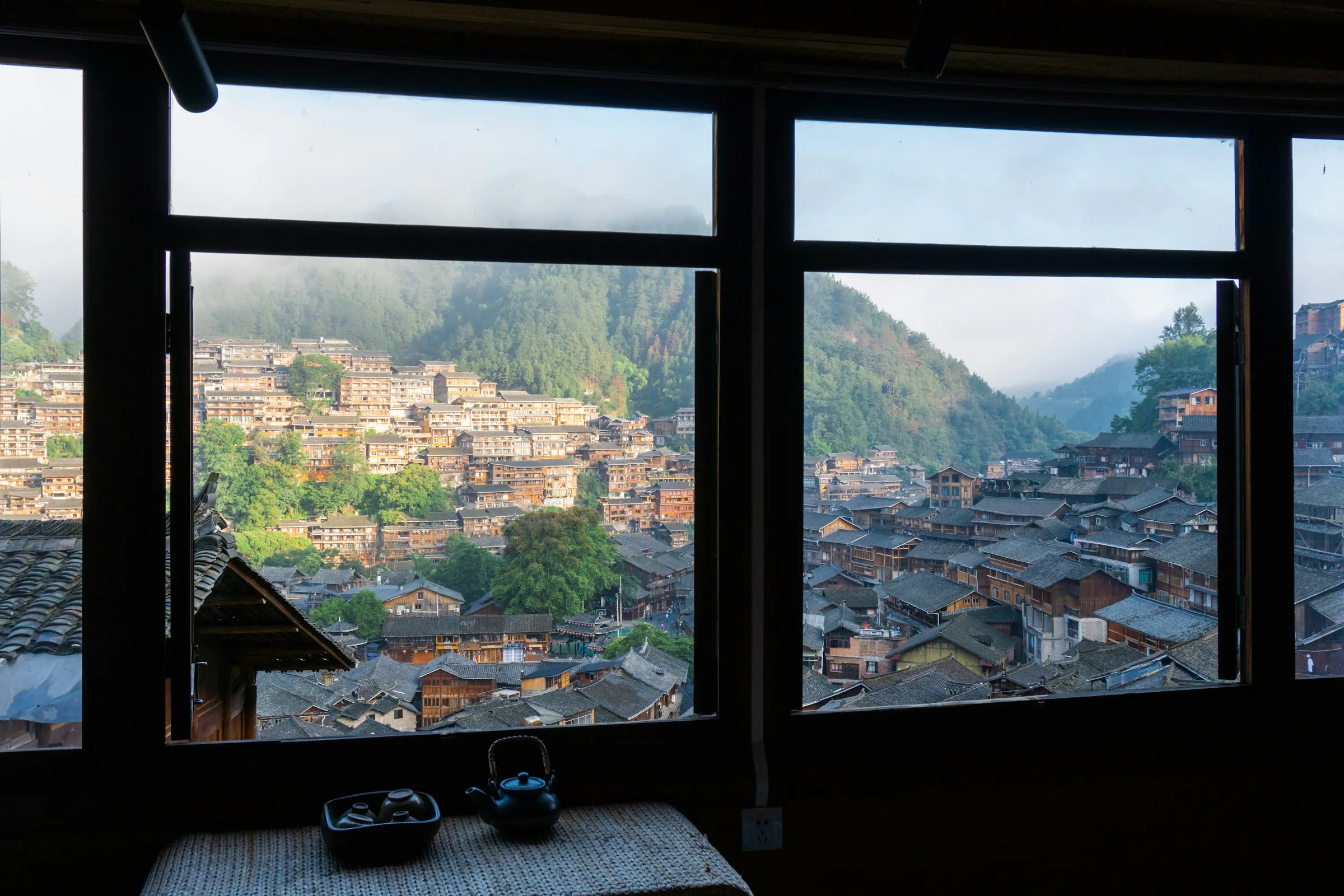
We arrive in Zhaoxing on the slow road from Liping, the last twenty kilometres climbing through terraces still flooded from the May planting. The village sits in a fold of the mountains in southeast Guizhou, and the first thing visible from the ridge is not a roof but a sound: lusheng practice drifting up from the Renduan drum tower, the reed pipes finding then losing a single sustained chord. It is six in the evening. Smoke from cedar fires moves sideways along the valley. Five drum towers, one for each of the village's clan groups, stand above the tiled roofs like dark wooden cones, each tier narrower than the last.
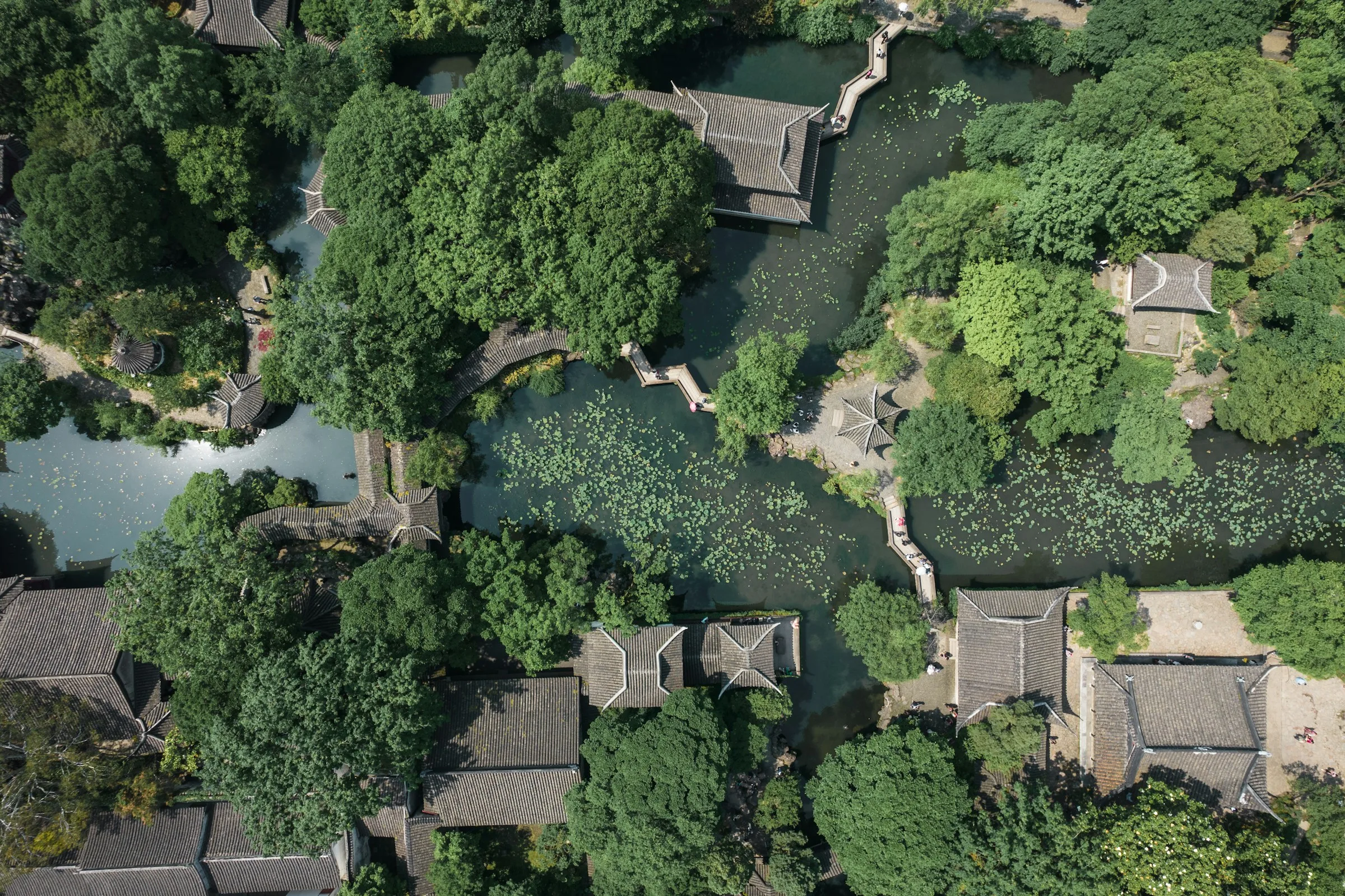
We have come to sit with Mr Lu, a Dong master carpenter in his late fifties, who has agreed to a week of conversation about the wind-and-rain bridge he is repairing on the village's south edge. The bridge, the fengyu qiao, is the one tourists photograph: a covered span across the Zhaoxing river with a tiled roof, raised pavilions at each end, and benches running the full length of the interior so that farmers can sit out of the rain. It is, in the local idiom, a bridge you can live a small life inside.
Mr Lu meets us in the open-sided workshop he keeps behind his house, a structure that is itself an argument for his craft. There are no nails in the roof above us. The cedar beams are joined by sunmao, mortise-and-tenon, the tenons cut so that the wood tightens against itself as it dries. He shows us a half-finished joint on the bench, a beam destined for the bridge's third bay. The mortise is square, the tenon slightly tapered. When he taps it home with the flat of his hand, there is a soft, final sound, like a book closing.
The bridge has stood, in one form or another, for close to eight hundred years. The current structure dates, Mr Lu thinks, to the late Qing, with substantial rebuilds in the 1950s and again after a flood in 1996. None of these dates are written down in the village; they are held in the heads of three or four older carpenters and disputed at New Year. What is not disputed is the method. The standard unit is sixteen square metres. Everything else, Mr Lu says, is a multiple, a division, or a quiet argument with that number. Drum tower bays, bridge spans, the footprint of a new house: all of them begin with a length of bamboo cut to the sixteen-square-metre base and then folded against the site.
“The standard unit is sixteen square metres. Everything else, Mr Lu says, is a multiple, a division, or a quiet argument with that number.”
We walk down to the bridge in the morning. The river is low and brown. Mr Lu points to a beam he replaced in 2019, a piece of cedar he selected in the forest above Tang'an and floated down after the autumn rains. The replacement is visibly lighter than the wood around it. In ten years, he says, you will not be able to tell them apart. He runs a thumb along the seam where new beam meets old and there is no gap. The joint was cut by his second apprentice, the one who has not yet left.
There were, until two years ago, four apprentices. Three are now in Guangzhou, working on residential high-rises along the Pearl River. They send money home and photographs of poured-concrete columns. Mr Lu does not speak of them with bitterness, only with the patient attention of a man who has watched water find its level many times. They were good with the chisel, he says. The youngest could read the grain in a beam in a single glance. He hopes one of them will come back when his own father grows too old to farm. He does not say which one.
In the afternoon we sit in the Renduan drum tower with three older men who have walked up from the lower village. The tower is thirteen tiers high and entirely wooden, the central pillar a single cedar trunk. Smoke rises from a small fire on the stone hearth at the centre, and the men pass a long pipe of locally grown tobacco. The conversation moves between Mandarin and the southern Dong dialect, with the older speakers shifting into Dong whenever the subject turns to carpentry. There are words, Mr Lu tells us later, for joints that have no Chinese equivalent. The word for the slight upward curve at the eaves, he says, also means the lift of a woman's voice at the end of a question.
The 2008 UNESCO inscription debate still surfaces in these conversations, quietly and without resolution. Zhaoxing was put forward, along with several other Dong villages, and the application is still pending in some bureaucratic form. The older men are sceptical. Inscription would bring more visitors, more money for restoration, and also, they suspect, a freezing of the village at a particular moment, the moment that photographs best. Mr Lu's view is more practical. If inscription pays for cedar, he says, it is welcome. If it tells him how to cut a tenon, he will ignore it.
We walk to the next valley on the third day. Half an hour from Zhaoxing, the wooden houses begin to give way to two-storey brick structures with aluminium roofs, painted blue. The aluminium is lighter than tile, cheaper, and does not need replacing every fifteen years. It is also, Mr Lu observes without judgement, louder in rain. He stands for a long time at the ridge between the two valleys, looking at the blue roofs catching the late sun. The question of what a Dong village should look like in 2026 is not, he says, one he can answer alone.
On our last evening, the rain comes in heavily from the south. We take shelter in the wind-and-rain bridge with perhaps thirty villagers and a small herd of ducks. The benches fill from both ends inward. A grandmother unwraps sticky rice from a banana leaf and passes pieces along the row. The tiled roof holds. Above us, the beams Mr Lu has cut and fitted bear the weight of the rain and the weight, also, of every previous rain. The lusheng begin again from the drum tower, faint and unhurried, finding their chord.
We leave Zhaoxing the next morning on the same slow road. Mr Lu walks with us as far as the edge of the village, where the new concrete road meets the older stone one. He has his measuring bamboo with him, marked at the sixteen-square-metre base, and he is on his way to look at a site where a young couple have asked him to build a house. The apprentices, he says again, may yet come back. He does not look at us when he says it. He looks at the bamboo, and at the road that runs south toward Guangzhou, and then he turns and walks back into the village.
— ArtoEast
Photography by 花茶 利酒 via Unsplash.
We design residencies, faculty-led programmes, and curated delegations around exactly this kind of work.
For universities, museums, cultural institutions, and other groups serious about understanding China at the level the essay above describes.
Programmes are designed bespoke. Tell us who is coming and what they are hoping to understand — we propose from there.
Start a conversation