ArtoEast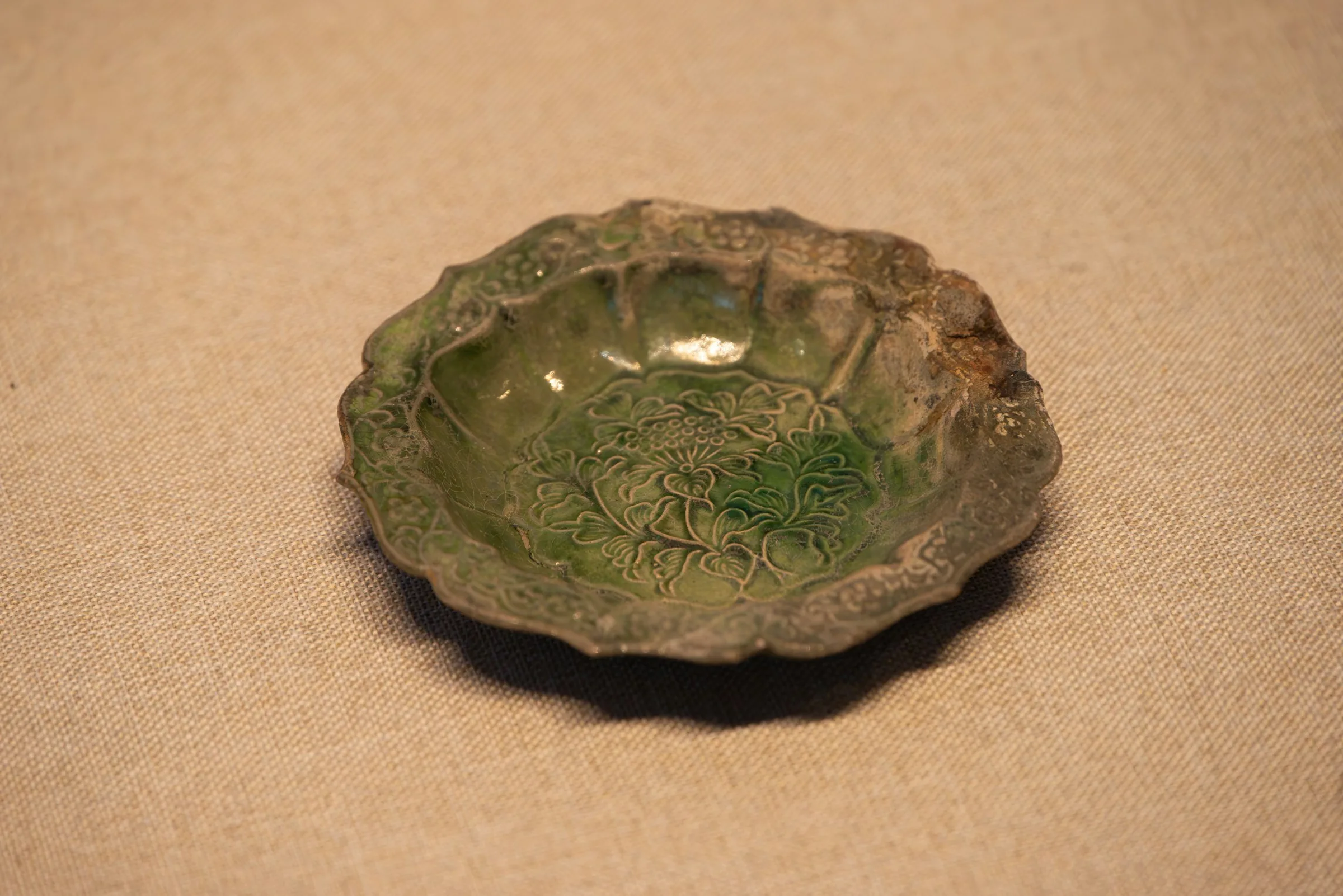
A Longquan Kiln Chasing Song
In Dayao village, eight centuries after the great Geyao and Diyao kilns cooled, a potter and his dog keep firing toward a colour no one alive has seen.
We arrive in Dayao on a Tuesday in late March, the kind of damp grey afternoon the Ou River valley specialises in. The bus from Longquan city drops us at a bend in the road; from there it is twenty minutes on foot, past tea terraces still bare from winter, to the compound where Xu Chaoxing has been firing celadon for forty-one years. His dog, a small yellow mongrel named Doudou, meets us at the gate. Xu is already in the shed behind the house, sorting pine billets by weight. He does not look up. We sit on a low bench against the wall and wait.
The kiln is a dragon kiln, long and narrow, climbing the slope behind the studio in eight chambers like vertebrae. It is a smaller cousin of the Song-era kilns whose foundations archaeologists still pull from the hillsides around here. Xu rebuilt this one in 1998 on the footprint of a Qing predecessor, which sat on the footprint of something older. He says the brick at the lowest chamber, near the firebox, came out of a creek bed half a li downhill, scorched on one face. Song, probably. He shrugs when he says it. In Dayao, Song shards are the gravel of ordinary life.
What he is chasing, what every serious potter in this valley is chasing, is mei-zi qing — plum-green celadon, the pale blue-green of an unripe plum held against an overcast sky. It was perfected, briefly, in the Southern Song, somewhere between 1127 and 1279, at the Geyao and Diyao kilns whose exact relationship scholars still argue about. Then it was lost. Not all at once; in slow degradations, generation by generation, as the iron content of local clay drifted, as the pine forests thinned, as the reducing atmosphere inside the kiln became a thing potters described to their sons rather than a thing they could reliably summon.
Xu shows us a shard he keeps on the windowsill of the studio. It is the size of a thumbnail, the colour of shallow seawater over pale sand. He found it in 1987, in the bed of a stream behind his uncle's house, when he was eighteen. He has been trying to reproduce that exact colour ever since. He has come close, he says, perhaps four times. He keeps those four pieces in a wooden box under the work table and does not bring them out for visitors. We do not ask.
“Eight hundred years of trying to remember a colour, and the smallest unit of failure is a single firing.”
The clay is local, dug from a seam on the north side of Fengyang Mountain, rich in iron oxide and a particular fine kaolin that gives the body its slight translucence at the rim. The glaze is layered — three, sometimes four, sometimes five coats, each dried for a day between applications. The thickness of the glaze is part of the colour; too thin and it goes yellow-grey, too thick and it crawls and pools. Xu mixes his glaze in a stone trough by feel. He does not weigh ingredients. When we ask the ratio he says, in the local dialect, that the ratio is the question, not the answer.
Loading the kiln takes two days. Each piece sits inside a saggar, a coarse clay box that protects it from direct flame and ash. The saggars are stacked in columns, the columns spaced so flame can move between them. The first chamber, nearest the firebox, runs hottest and is reserved for test tiles and pieces Xu is willing to lose. The fifth and sixth chambers, in his experience, give the cleanest mei-zi qing when everything else goes right. The eighth, at the top of the slope, is for the small bowls his wife sells to a shop in Hangzhou that pays the electricity bill.
He fires with pine. Not because pine is romantic but because pine, burned fast, gives a long lazy flame and the specific quality of reduction — the oxygen-starved atmosphere — that turns iron oxide in the glaze from rust-red to that pale green. Coal would be cheaper. Gas would be predictable. Pine is neither. He cuts and stacks it himself, two years ahead, under a tin roof against the studio's east wall. The wood for next year's firings is already drying.
The firing itself runs about thirty hours. Xu sleeps in two-hour stretches on a cot beside the firebox. Doudou sleeps under the cot. Every twenty minutes someone — Xu, his nephew, occasionally his wife — feeds the firebox a careful armful of split pine, watching the colour of the flame through a peephole the size of a coin. The colour tells you the temperature; the smoke tells you the atmosphere. A sudden shift in the wind off Fengyang Mountain, a change in barometric pressure as a front rolls in from the East China Sea, and the reduction breaks. The glaze, when the kiln cools five days later, will be the wrong colour. Eight hundred years of trying to remember a colour, and the smallest unit of failure is a single firing.
We are here for the closing of the firebox. Xu does it himself, just after midnight on the second day. He pushes a final load of pine deep into the throat, watches the flame for perhaps two minutes, then bricks up the opening with clay he has kept wet in a bucket. The silence afterwards is the loudest thing we encounter in Zhejiang. The kiln ticks as it begins to cool. Doudou sighs and rearranges herself. Xu sits down on the bench beside us and accepts a cup of tea from his wife. He does not speak for perhaps ten minutes. Then he says, in Mandarin so we will understand: now we wait, and the kiln decides.
The kiln will be opened on Sunday. We will not be here for it. Xu prefers it that way, he tells us — fewer faces when the saggars come out, fewer reactions to manage if the batch is poor. He estimates, across forty-one years, that perhaps one firing in seven gives him a piece he is willing to keep. The rest he sells, or breaks, or stacks in the lean-to behind the kiln where the shards have been accumulating since 1998. The pile is now waist-high. In four hundred years, we think, someone will dig through it and find a fragment the colour of an unripe plum and wonder what was lost.
Walking back down to the road in the morning, we pass the creek where Xu found his shard in 1987. The water is high from spring rain, the colour of weak tea. We do not stop to look. It feels, after the kiln, like the wrong gesture — the kind of thing a tourist would do. Doudou follows us as far as the tea terraces and then turns back. The bus to Longquan city comes at 9:40. We are quiet on the ride down, and for most of the train back to Hangzhou, and for some time after that.
— ArtoEast
Photography by ran liwen via Unsplash.
We design residencies, faculty-led programmes, and curated delegations around exactly this kind of work.
For universities, museums, cultural institutions, and other groups serious about understanding China at the level the essay above describes.
Programmes are designed bespoke. Tell us who is coming and what they are hoping to understand — we propose from there.
Start a conversation