ArtoEast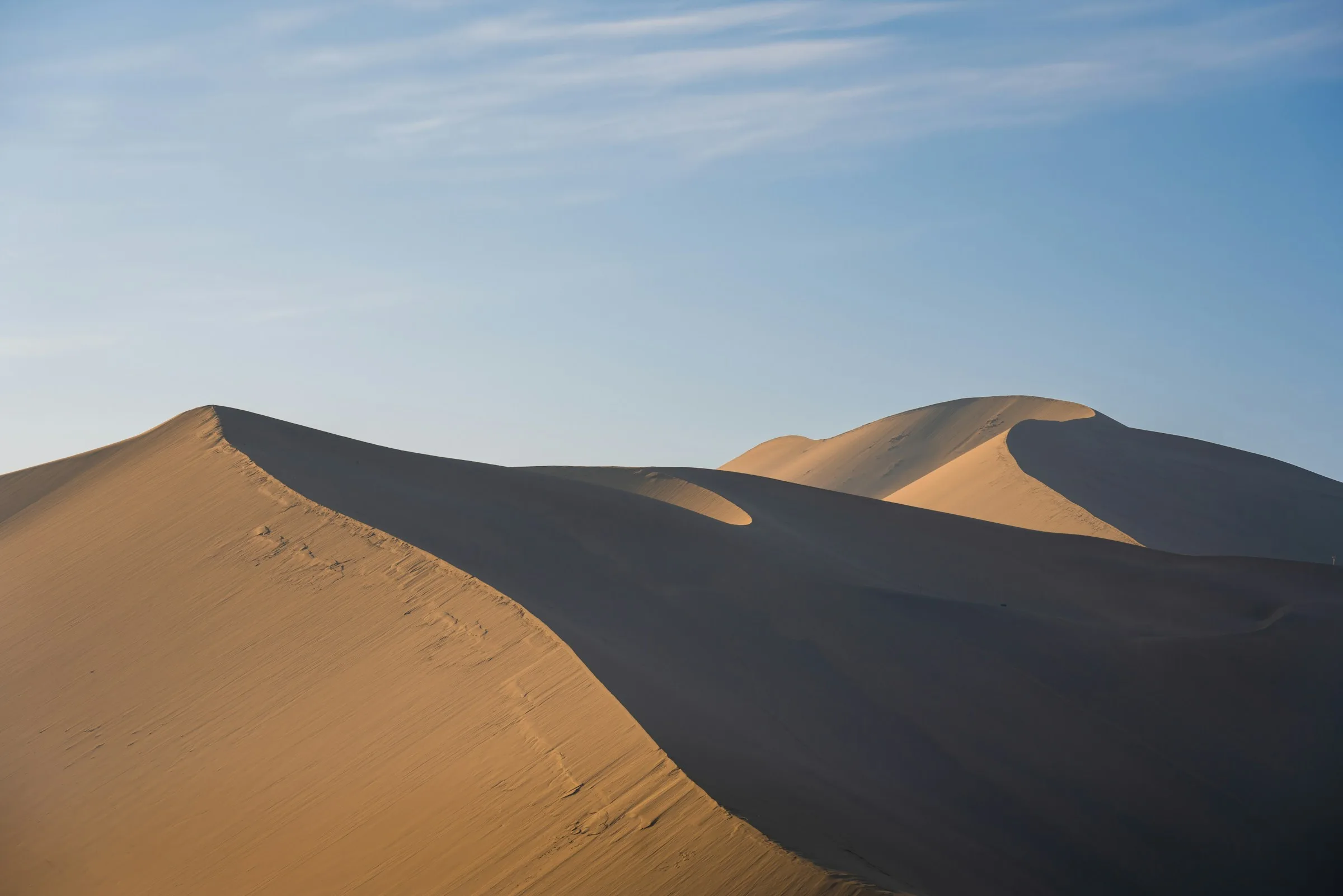
Mogao on a Tuesday, with the Conservator
A morning at the Dunhuang cliff face, where four hundred and ninety-two caves hold fifteen centuries of pigment and one researcher's nineteen-year conversation with Cave 17.
We arrive at the cliff at seven-forty, before the first bus from the visitor centre. The wind off the Gobi is already up, fine and dry, carrying a grit that catches in the teeth. Li Wenjuan meets us at the lower gate in a navy fleece with the Dunhuang Academy patch on the sleeve. She does not say good morning. She points to the poplars along the Daquan River and says they were planted in the 1940s, when Chang Shuhong first walked here from Chongqing to start what is now the Academy. The trees, she says, are the second-oldest thing on the site that is still alive. The first is the lichen.
Mogao is not one cave. It is four hundred and ninety-two surviving chambers cut into a conglomerate cliff one and a half kilometres long, the earliest from the fourth century, the latest from the fourteenth. The 8,000-visitor daily cap is administered from the new centre eight kilometres east, where groups watch two films and are then bused over in batches of twenty-five. We are here on a researcher's pass, which means we walk at Li's pace and stop when she stops.
She stops first at Cave 285. Western Wei, 538 to 539 by the dated inscription. The walls hold a Vimalakirti debate scene, the layman reclining on his couch, Manjushri opposite with attendants. Li switches off her torch and lets our eyes adjust. The azurite in the sky behind Vimalakirti has held, she says, because the cave faces a particular way and the humidity stays inside a band. In Cave 254, two chambers north, the same azurite from roughly the same century has gone black in patches where copper has migrated. Same pigment, same century, different fate. She says this without drama, the way a doctor reads a chart.
We sit on a low bench at the back of 285 for almost twenty minutes. She does not narrate. Occasionally she lifts the torch to a flying figure or a small painted donor at the dado and waits for us to look. The malachite greens in the lower register have darkened to something closer to olive. The cinnabar reds, by contrast, are startling, almost wet-looking. Cinnabar is mercury sulphide, she says when we ask. It is chemically stable in the dark. Light is what undoes it, and the caves were dark for most of fifteen hundred years.
Outside, the temperature has climbed and the wind has dropped. Li walks us along the upper gallery to Cave 17, the so-called Library Cave, a small side chamber off the corridor of Cave 16. It is barely three metres across. Aurel Stein came through here in 1907, Paul Pelliot in 1908. Between them, and the later sales by the Daoist caretaker Wang Yuanlu, the contents of the chamber, perhaps fifty thousand manuscripts and paintings sealed since the early eleventh century, dispersed to London, Paris, St Petersburg, Tokyo, and Beijing. The cave is empty now except for a statue of the monk Hongbian, returned from elsewhere on the site.
“She studied at the Courtauld, came home, and has been sitting with Cave 17 for nineteen years, longer than most marriages.”
She studied at the Courtauld, came home, and has been sitting with Cave 17 for nineteen years, longer than most marriages. Her doctorate was on the Pelliot collection. The Bibliothèque nationale in Paris gave the Academy digital access to the manuscripts in the 2010s, which means she can read, on a screen in her office in Dunhuang, the Tang-dynasty sutras that left this room in a French cart in 1908. She does not call this restitution. She calls it dialogue. The physical paper is in Paris. The reading is here.
We ask her about the Sutra of the Great Decease cycle in Cave 158, the great reclining Buddha, eleven metres long, Tang. She says we will not see it today. The schedule rotates: certain caves open on certain days, partly to manage CO2 and humidity, partly so that any given mural rests in darkness most of the year. She is not apologetic. The caves outlast the schedule. The schedule serves the caves.
Lunch is at a cafeteria on the Academy side of the river, a fluorescent room with steamed buns and a thin lamb broth. Li eats quickly and talks about the digital scanning project, which began in the late 1990s and has now captured, at sub-millimetre resolution, more than two hundred and seventy caves. The data sits on servers in Lanzhou. The question is not whether to scan, she says. The question is what scanning is for. A scan is a hedge against the cliff. It is not the cliff.
This brings her to restoration. She uses the English word carefully and then prefers the Chinese, baohu, which translates closer to safeguarding. The Academy's position, refined over decades under Fan Jinshi and now her generation, is that intervention should be reversible and minimal. They consolidate flaking plaster with a dilute acrylic that can be removed with the right solvent. They do not repaint. A missing face stays missing. A blackened azurite sky stays blackened. We attend to the wall, she says, we do not improve it.
In the afternoon she walks us through Cave 45, High Tang, the famous attendant bodhisattva on the south wall whose hip is cocked in a way that has launched a thousand postcards. Li looks at the figure the way a craftsperson looks at another craftsperson's work. She points out where the modelling line, the iron-red contour drawn first, shows through the flesh tone above. The painter worked fast and confidently. She thinks he was about thirty. She has no evidence for this. It is observation, accumulated over nineteen years.
We end the day at Cave 96, the nine-storey pagoda that holds the thirty-five-metre Maitreya, Tang again, repaired in the Qing. Outside, the cliff is in shadow and the desert beyond is still in full sun. Li says that on clear nights the Academy staff sometimes walk up the path behind the caves to look at the sky. There is almost no light pollution. The Milky Way runs the length of the cliff. The painters of Cave 285, she says, would have seen the same sky and used some of the same azurite to paint it on the ceiling.
She locks the gate at six. The last visitor bus has left. The wind has come back up, finer now, and the poplars are turning. We walk down to the road in silence. Tomorrow she will be in the conservation lab, running a pigment sample from a flaking patch in Cave 254 under a portable XRF. The dialogue with Pelliot will continue on her screen. The cliff will hold.
— ArtoEast
Photography by ダモ リ via Unsplash.
We design residencies, faculty-led programmes, and curated delegations around exactly this kind of work.
For universities, museums, cultural institutions, and other groups serious about understanding China at the level the essay above describes.
Programmes are designed bespoke. Tell us who is coming and what they are hoping to understand — we propose from there.
Start a conversation