ArtoEast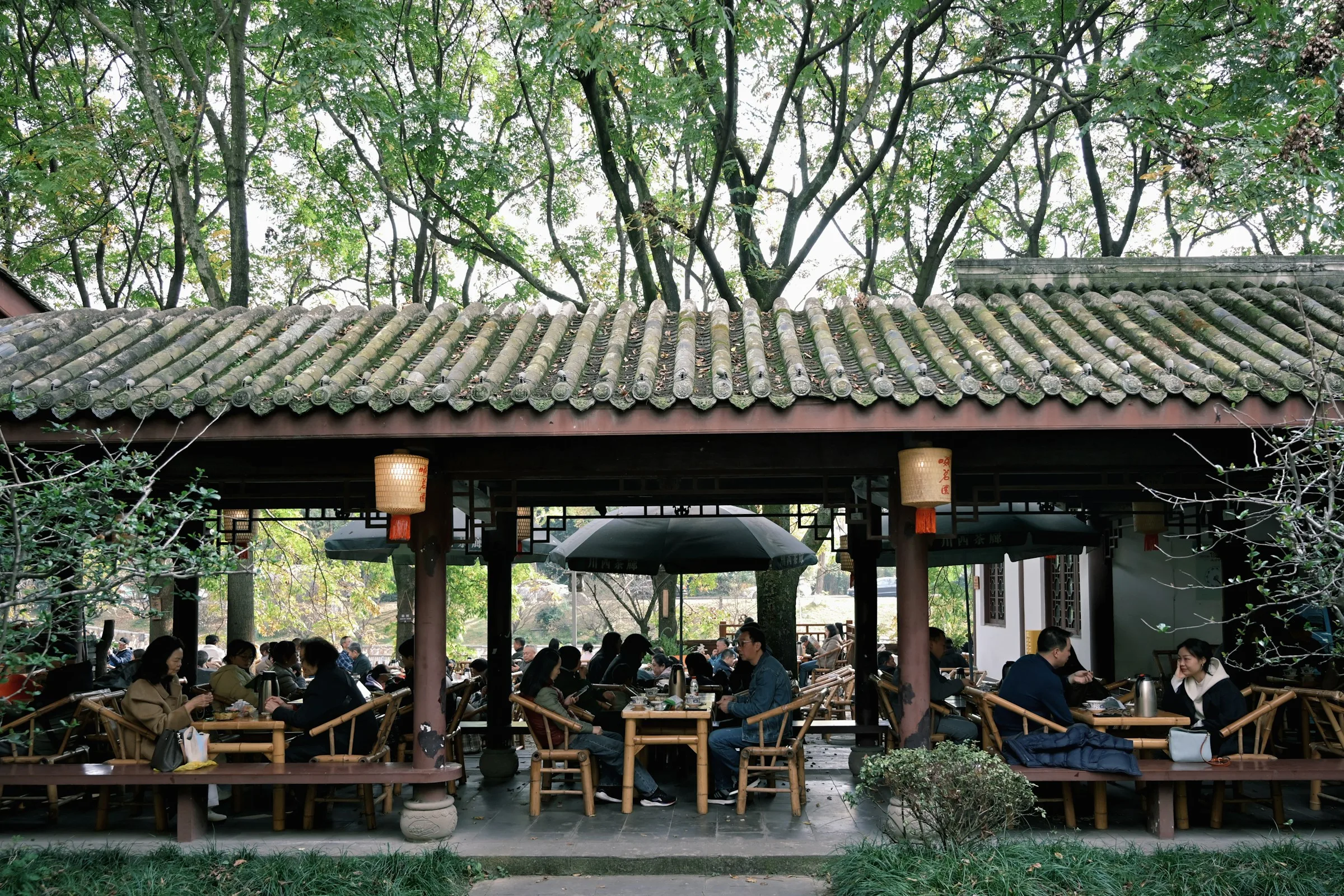
Chengdu, between two sips at He Ming
An afternoon at He Ming Cha She in People's Park, where bamboo armchairs, an ear-cleaner's tuning fork, and a covered bowl of jasmine keep the slowest hour in the city.
Just after two on a Wednesday in April, the bamboo armchairs at He Ming Cha She are already three-quarters full. The chairs (zhuyi, woven from split bamboo by a workshop two hours west, in Qionglai) are arranged not in rows but in soft clusters under the camphor laurels, so that whichever way you sit, you face someone. A waiter walks the gravel paths with a long-spouted brass kettle, refilling the gaiwan in front of an old man who hasn't lifted his eyes from his newspaper. The newspaper is the Chengdu Shangbao. The date is current. The posture, we suspect, is not.
He Ming Cha She has been here, inside Renmin Gongyuan, since 1923. It survived the Sino-Japanese War, the Cultural Revolution, the bulldozing of most of old Chengdu in the late 1990s, and the more recent threat of being made too tidy. The building itself is modest — a pavilion, really, with overhanging eaves and a tile roof darkened by a century of camphor smoke — and the tea menu is short. Jasmine (molihua) is the house standard, served loose in a covered bowl. Zhuyeqing, the green from Mount Emei, is the next step up. A small bowl is fifteen yuan, refills included, all afternoon.
We sit with Mr Luo, who arrived at nine. He will leave at five. He has been doing this, he says, four days a week since he retired from the railway bureau in 2008. He drinks zhuyeqing because the doctor told him jasmine was too warming for his constitution. He does not consult the doctor often. The gaiwan in front of him — porcelain lid tilted to one side to let steam escape and to signal he is still drinking — has been refilled, he estimates, eleven times. The water is from a thermos the waiter carries on a shoulder strap; the kettle is for show, and for the long, theatrical arc of the pour that the tourists film.
The Sichuanese around us are not speaking Mandarin. They are speaking Chengduhua, the local dialect, which sands the edges off the four tones of standard Mandarin into something flatter and more melodic, full of erhua endings and the soft particle sa at the end of half the sentences. A linguist friend once told us Chengduhua is closer to the speech of Tang-era poets than Beijing's putonghua is, though we suspect this is the sort of thing linguists say to flatter cities they love. Either way, we follow about one phrase in five, and the rhythm — leisurely, looping, full of unhurried agreement — is itself a kind of meaning.
A man with a tray of small steel implements moves between the chairs. He is the caier jiang, the ear-cleaner, and his trade is one of the last public ones left in China. He carries seven tools: a feather, a long thin pick, a pair of tweezers, a tiny brush, two probes of decreasing gauge, and a tuning fork. The tuning fork is the advertisement. He taps it against a pick, holds it near a customer's ear, and the sustained metallic ring — Erhuang B-flat, more or less — carries across the gravel and the conversation. Three heads turn. One nods. He sits down, ties a cloth around the man's collar, and begins.
“The teahouse keeps the slowest public infrastructure in a country obsessed with speed, and Chengdu defends it without ceremony.”
We watch for ten minutes. The work is intimate and entirely public — there is no booth, no curtain, just a bamboo chair under a tree and the tuning fork humming every few minutes when the caier jiang wants to reassure his customer (and recruit the next one) that the vibrations are pleasant. The price is twenty yuan. The conversation, which continues throughout, concerns the man's grandson, who has just been accepted to a university in Wuhan. There is no rush. The caier jiang does not look at his phone. We have not, we realise, seen him look at his phone once.
The mahjong tables sit further back, near the willows that lean over the artificial pond. The boards are magnetic — a Chengdu innovation we are told dates to the 1990s — so that the tiles do not slide when the players slap them down, which they do, often, with a percussion that sets the rhythm of the whole garden. Sichuan-style mahjong drops three of the suits and plays only with the dot tiles; it is faster, more aggressive, more about reading faces than counting tiles. The four women at the nearest table are perhaps in their sixties. They have been here since after lunch. The pot is small. The stakes, we gather, are mostly social.
We attend, in the looser sense — we are not playing, we are sitting nearby with our own gaiwan and a paper bag of melon seeds — to a conversation between two men at the next cluster. One is Professor Tang, a poet who taught modern Chinese literature at Sichuan University for thirty-six years and is now, at seventy-three, emeritus in the strict sense: free of meetings. He has been writing at He Ming, he tells us, for forty years. He gestures at the notebook on his knee: a fountain pen, blue ink, a half-finished line about the way the camphor laurels in April release their old leaves at the same time as the new ones come in. He writes only here. At home, he says, the light is wrong.
We ask him the question we have been circling. The teahouse keeps the slowest public infrastructure in a country obsessed with speed, and Chengdu defends it without ceremony. Beijing has not done this. Shanghai certainly has not. Why has Chengdu? He thinks for a long time. The basin, he says eventually. The mountains close the city in on three sides and the rivers come down slow; the climate is humid and grey; the food is heavy; the temperament adjusts. There is, he adds, also a politics in it — a quiet insistence that public life can be unproductive and still be public. He does not press the point.
The smell, when the breeze shifts, is camphor and damp stone and the particular vegetal sweetness of jasmine steeping in hot water. The river willows along the pond move in the small wind. A child of maybe four runs between the chairs with a paper windmill; nobody minds. Somewhere a phone rings and is answered in Chengduhua, briefly, and put down. The tuning fork sounds again from a different corner. Mr Luo's gaiwan is refilled for the twelfth time.
We came expecting nostalgia and find something more durable. He Ming is not a museum and it is not staged. The bamboo chairs are replaced when they break, by the same workshop in Qionglai, in the same weave. The caier jiang trained under his uncle, who trained under his uncle. The professor's notebook is new but the practice is old. The question of whether the teenagers walking past on their way to the lake — earbuds in, phones up — will inherit this rhythm is not, we think, ours to answer, and the regulars do not seem worried. The afternoon, in any case, will continue without us.
We pay our fifteen yuan, leave the lid tilted on the empty bowl as a courtesy to the waiter, and walk out past the gate at four. The light through the camphor laurels is yellow. Inside, the mahjong tiles continue their percussion. Somewhere behind us, the tuning fork sounds once more, and a stranger turns his head.
— ArtoEast
Photography by อีหมิน หม่า via Unsplash.
We design residencies, faculty-led programmes, and curated delegations around exactly this kind of work.
For universities, museums, cultural institutions, and other groups serious about understanding China at the level the essay above describes.
Programmes are designed bespoke. Tell us who is coming and what they are hoping to understand — we propose from there.
Start a conversation