ArtoEast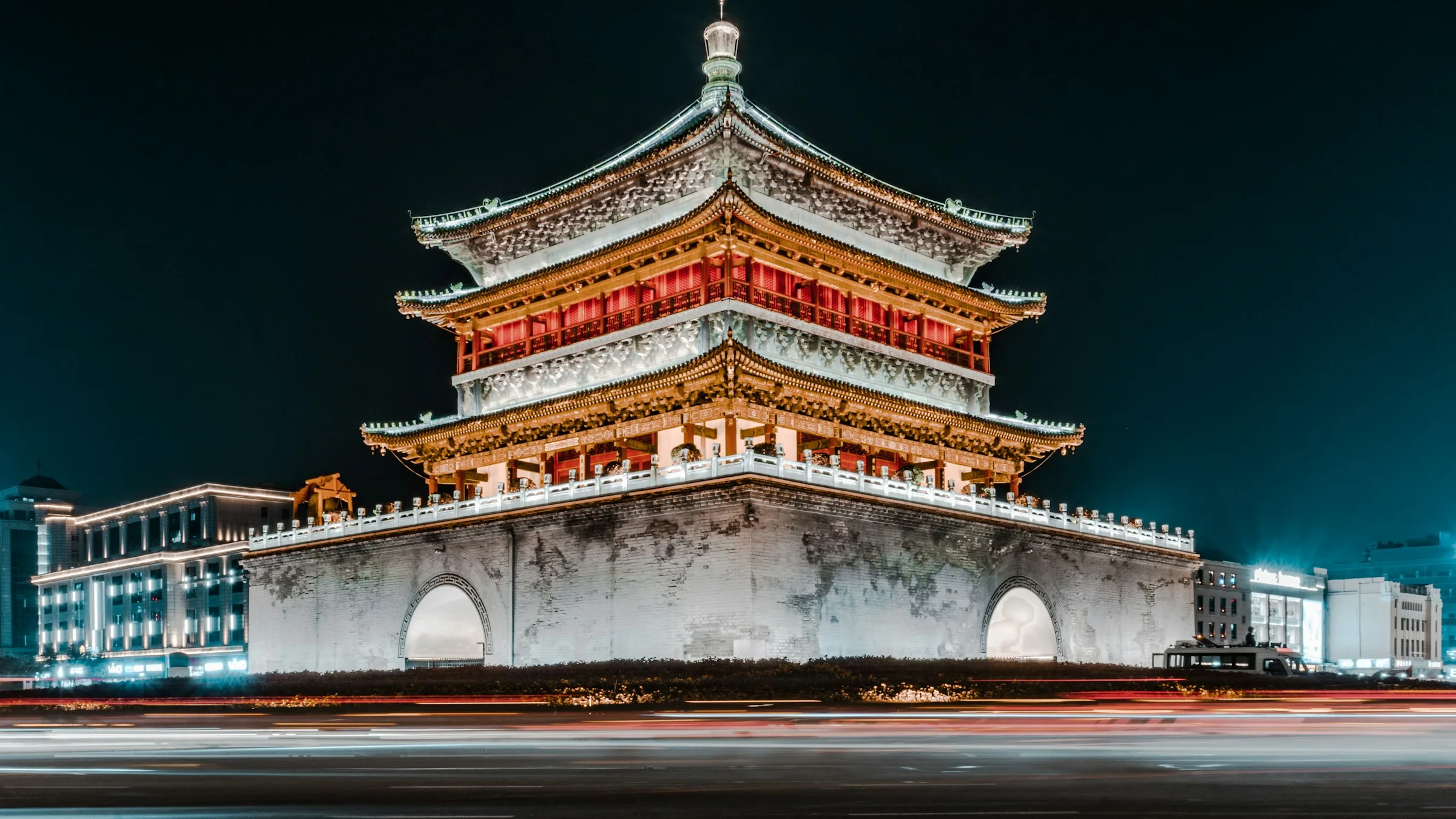
What lies under Xi'an, eight metres down
A Tang grid still shapes the streets above, while subway crews, archaeologists, and developers negotiate the city pressed beneath them.
At a quarter past five on a thin April morning, the Bell Tower at the centre of Xi'an is the only lit object on its roundabout. The Ming-dynasty timbers above the drum platform glow ochre, and the four avenues that meet beneath it — North, South, East, West — run dead straight to the gates of the old walled city. We sit on the stone kerb opposite a closed jianbing cart and watch the first taxi describe a slow arc around the tower. The driver does not cut across the square. He follows the grid. Nobody told him to.
The grid is older than the tower by seven centuries. When Sui emperor Wen ordered Daxing built here in 582, his architect Yuwen Kai pegged out a rectangle of roughly 84 square kilometres and divided it into 108 walled wards, with Zhuque Avenue running 150 metres wide from the Ming De Gate in the south to the Imperial City. The Tang kept the bones and renamed it Chang'an. Most of the wards have dissolved into apartment blocks and ring roads, but the cardinal axes survive. Modern Xi'an's bus routes, the way taxis queue, the orientation of every state-built danwei courtyard from the 1950s — all of it still defers to Yuwen Kai's chalk lines.
We had come to sit with Mr Hou, a retired field archaeologist who spent thirty-one years at the Shaanxi History Museum and now teaches a Saturday class for amateur conservators in a back room near the South Gate. He arrives at six, with two thermoses and a folder of subway-survey photographs, and waves us into a tea house that has not yet unlocked its front shutters. The owner is his cousin. We drink Fu brick tea from Jingyang, the dark earthy kind pressed into bricks for the Silk Road caravans, and Mr Hou begins, without preamble, with the day Line 2 stopped.
It was October 2008. The southbound tunnel-boring machine, working between Zhonglou and Yongningmen stations, met something the geotechnical survey had not flagged. Eight metres down, the Sui builders had laid a rammed-earth wall two armspans thick, and the tunnel-boring machine had simply stopped. The crew thought it was rock. When the archaeology team arrived, they found the wall ran north-south, perfectly aligned with the modern street above. It was a section of the inner wall of the Imperial City, last seen above ground in the early Ming. The route was rerouted by four metres and the depth dropped by another two. The trains now pass beneath the wall rather than through it. Most riders on Line 2 do not know this.
Mr Hou opens the folder. The photographs show the wall in section: pale grey loess compacted in layers about ten centimetres thick, each layer a single day's work by a single team in 583. You can count the days, he says, the way you count rings in a tree. Above the Sui layers, a thinner band of darker earth marks a Tang repair after the An Lushan rebellion. Above that, Yuan-era rubble. The wall is a calendar that nobody meant to keep.
“Eight metres down, the Sui builders had laid a rammed-earth wall two armspans thick, and the tunnel-boring machine had simply stopped.”
We walk north after breakfast, along Beiyuanmen, past the Great Mosque tucked behind the Muslim Quarter's grilled-lamb stalls. The muezzin is calling fajr from a speaker mounted on the Phoenix Hall — the mosque's prayer hall built in 1392 in the form of a Chinese temple, with upturned eaves and a wooden minaret shaped like a pagoda. The call mingles with the scrape of hutong sweepers' bamboo brooms on the flagstones, and with the soft electric whirr of the first delivery scooters. None of the three sounds gives way to the others. They occupy the same air at different frequencies.
Further out, near Daming Palace, the situation is harder. The Tang imperial complex covered 3.2 square kilometres — about four and a half times the Forbidden City — and most of it lies under a 1990s residential district called Taihua Lu. When a developer breaks ground on a new tower, the law requires a survey trench. Mr Hou says the unspoken protocol has three tiers. Things of catalogue interest — Han ceramic shards, Tang roof tiles, the bones of a household pig — are recorded, photographed, and reburied in situ so construction can continue. Things of museum interest — a complete Tang tri-colour figure, a stele with legible characters — are lifted and accessioned. Things of monument interest — a hall foundation, a palace gate — stop the project. The line between catalogue and museum is sometimes drawn in a Friday-night phone call.
He tells us about a 2019 high-rise foundation near Hansenzhai where the excavator hit a Han-era family graveyard, six shaft tombs in two rows. The developer had already poured a perimeter wall. After three weeks of negotiation, the tombs were excavated, the bronzes and a lacquered comb went to the museum, and the foundation was redesigned around a sealed concrete plinth that preserves the grave shafts beneath the building's lobby. The plinth has a small bronze plaque. Nobody from the building's 340 households has asked Mr Hou what is underneath their feet, and he is unsure whether this counts as success.
The Famen Temple story he tells more carefully. In August 1981, after a week of rain, the Ming-dynasty pagoda at Famen, 120 kilometres west of the city, collapsed on its western face. The eastern half stood for another six years while the provincial government argued over whether to demolish or restore. When the crypt beneath was finally opened in 1987, archaeologists found a four-chambered Tang reliquary holding, among other things, a silver-gilt crane with feathers individually chased, and the finger bone of Sakyamuni in a nest of nested caskets. Had the eastern half come down in the original collapse, Mr Hou says quietly, the crypt would have been looted within a fortnight. Conservation, he adds, sometimes depends on the weather choosing the right side.
Late morning we walk the southern stretch of the city wall, the Ming rebuild, fourteen kilometres of brick over the Tang and Sui rammed-earth core. The bricks are stamped with the kiln of origin and the supervising official's name — a quality-control system from 1370 that Mr Hou says he has seen reinstituted, in spirit, in the current restoration contracts. Every replacement brick carries a small incised date. In two centuries somebody will read 2024 the way we read 1370, and the wall will continue its slow conversation with itself.
We end at the Forest of Steles, in a courtyard where a craftsperson in a blue cotton coat is taking ink rubbings from a Tang stele for a university order. She works without speaking, tamping the paper into the carved characters with a felt pad, then rolling ink across the raised surface. Each rubbing takes about forty minutes. The stele itself, carved in 781 to record the arrival of Nestorian Christianity in Chang'an, has been rubbed perhaps a hundred thousand times and the characters are still sharp. Loess stone, she tells us, when we ask. It gives up its surface slowly.
On the taxi back across the grid, the driver again refuses to cut the corner. The Bell Tower passes on our right, then the South Gate, then the long straight run of what used to be Zhuque Avenue and is now Chang'an Lu. Eight metres beneath the asphalt, Mr Hou's wall is still there, and the train is passing under it, and somewhere a developer is waiting for a Friday phone call. Above ground the city behaves as if none of this is happening. The grid holds. We get out at the hotel and the driver, without being asked, points the cab back north along the axis.
— ArtoEast
Photography by Harrison Qi via Unsplash.
We design residencies, faculty-led programmes, and curated delegations around exactly this kind of work.
For universities, museums, cultural institutions, and other groups serious about understanding China at the level the essay above describes.
Programmes are designed bespoke. Tell us who is coming and what they are hoping to understand — we propose from there.
Start a conversation