ArtoEast
M50 After the Opening: A Saturday in Shanghai's Gallery District
Half past nine on Moganshan Road, the press has gone home and the actual conversation about Chinese contemporary practice begins under fluorescent loading-dock light.
The wine has gone warm in the plastic cups by 9:30 p.m. and the gallerist at ShanghART has begun stacking the folding chairs along the wall, slowly, the way you stack chairs when you do not actually want the evening to end. Outside on Moganshan Road, the row of converted textile warehouses that make up M50 sits in that particular Shanghai half-dark where the sodium lights buzz over the cobbles and you can still smell the Suzhou Creek a block north, a smell that tonight is part diesel, part river silt, part fried chili oil drifting from somewhere we cannot yet see.
We had come for the opening of a group show, six painters under thirty-five, and we had stayed past the polite hour because the artist we most wanted to sit with, a woman from Hangzhou who paints in xuan ink on raw linen, had spent the first three hours of her own opening standing slightly behind a column, watching collectors photograph her work without looking at it. She is twenty-nine. This is her first Shanghai show. She has not eaten since lunch.
The piece everyone keeps circling is a two-metre vertical: ink ground into linen so the warp shows through, the image somewhere between a Song landscape and the aerial view of a flooded rice terrace. She used a brush her grandfather cut for her in 2019 from a single weasel-hair bundle. We ask how it travels from Hangzhou to here and she says, in Mandarin and then in careful English, that she rolls each work around a length of bamboo and carries it on the high-speed rail herself because the framers in Shanghai do not yet understand how raw linen wants to move in this humidity.
The gallerist, a man in his fifties who has been at M50 since the warehouses were still half-occupied by the old No. 12 Wool Spinning Mill, walks past us with two collectors and, without breaking conversation, reaches out and shifts an installation in the corner by perhaps eight centimetres. It is a small thing, a steel rod and a hanging length of dyed silk, and the correction is so quiet that the artist who made it, standing two metres away, does not register it. We only catch it because we are watching his hands. He does this kind of redirect, we are told later, three or four times a night during an opening week. Nobody mentions it. The work simply ends up where he wants it.
Around ten, a curator from the Long Museum out on the West Bund stops in on her way home from a board dinner, and the conversation shifts, the way it always shifts in this city, toward the gap between the two scenes. The West Bund Art Fair, two weeks out, will fill the riverside hangars with Gagosian and Hauser and Wirth and the kind of carefully translated wall text that signals to Basel and Frieze that Shanghai is ready. Out here on Moganshan, the rents are still climbing but the work is, in her phrase, allowed to be unresolved.
“The international market wants a legible Chinese contemporary, she says, but what we are making is mostly illegible to ourselves.”
The Hangzhou painter listens to this and then says something we write down in the small notebook we carry for exactly these moments. The international market wants a legible Chinese contemporary, she says, but what we are making is mostly illegible to ourselves. She is not being modest. She means it as a working condition. The xuan ink on linen is, in part, a refusal to choose between the ink lineage her grandfather trained her in and the contemporary painting program at the China Academy of Art where she did her MFA. The illegibility is the practice.
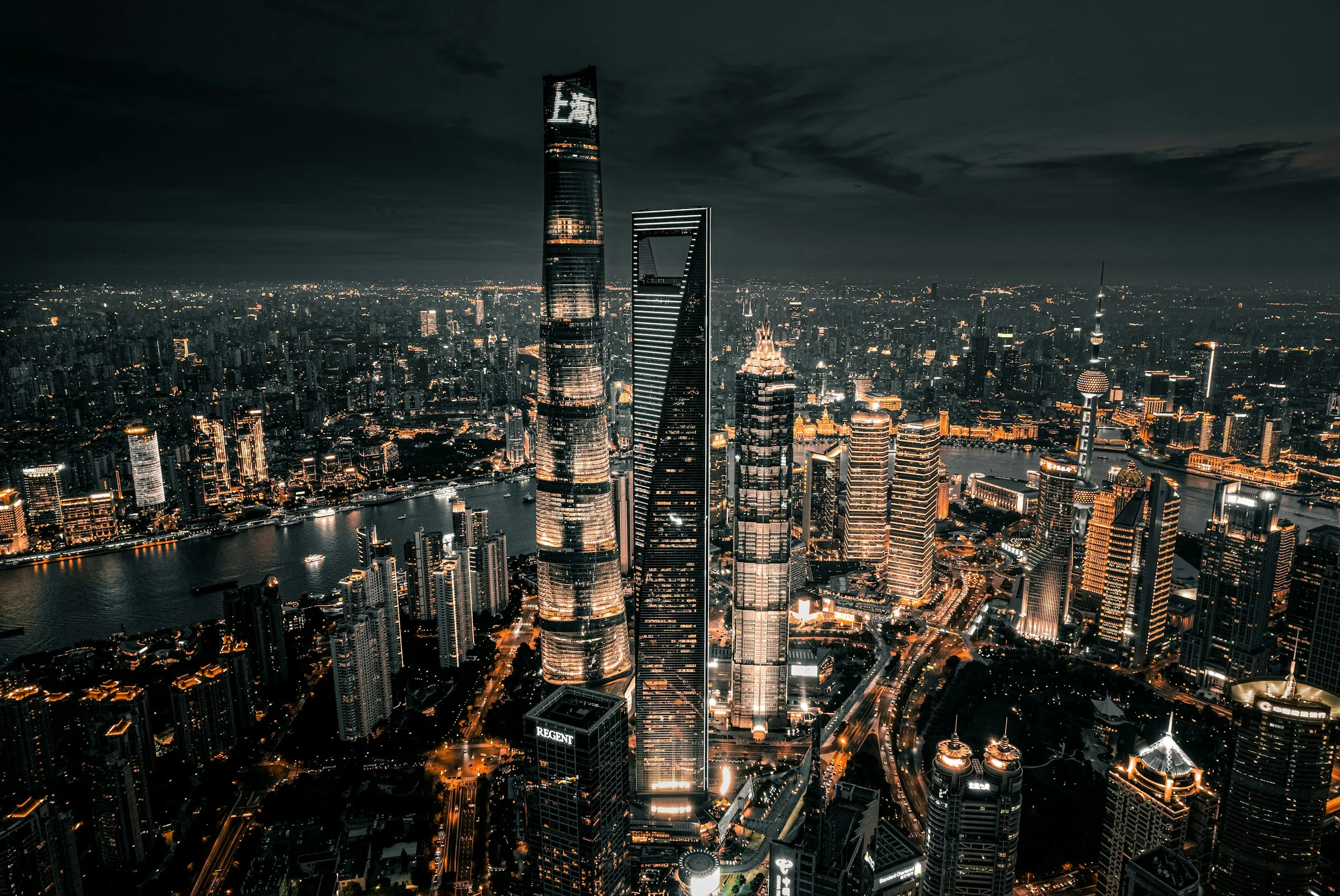
We walk out around eleven and cross under the Inner Ring Road overpass toward the river. The Power Station of Art is across the Huangpu, the old Nanshi Power Plant with its 165-metre chimney that the 2010 Expo renovated into a museum, and from this side of the water its silhouette is just a darker shape against the pink municipal sky. We do not go in. It is closed, and anyway the conversation is happening on this bank, in the small concrete plaza behind the M50 loading dock where a Sichuan noodle stall has set up under a single bulb strung from the awning.
The man at the wok is from Zigong, he tells us when we ask, and he has been parking his cart behind this particular dock on Friday and Saturday nights for eleven years. He knows the gallerists by their orders. The ShanghART director takes dan dan, no peanut. The curator from Long takes a clear broth with pickled mustard greens because she says the chili keeps her awake on the drive back to Xuhui. Tonight he makes us xiao mian with a spoon of his own chili crisp, and the Hangzhou painter, who has finally eaten, asks him in Sichuanese where his huajiao comes from. Hanyuan county, he says. She nods. They talk for a while about peppercorn grades and we do not interrupt.
A photographer we know from earlier in the week joins us with a bottle of cold Tsingtao and we climb the external stair of Building 6 to a rooftop that is not officially open to anyone, but the lock has been broken for years and the gallerists tolerate it. From up here you can see the Suzhou Creek bending east toward the Bund, the new residential towers on the north bank, and the low sawtooth roofs of the M50 warehouses still pitched the way they were pitched in 1937 when this was the Xinhe Cotton Mill. The painter stands at the parapet for a long time without speaking.
What she eventually says, half to us and half to the river, is that she is not sure whether showing in Shanghai is the beginning of her practice or the end of a particular freedom in it. Her Hangzhou studio is in a converted silk-reeling shed she shares with three other painters and a ceramicist. The rent is one-sixth of what an equivalent space inside the Inner Ring would cost. She can work at the scale she wants. She can leave wet linen on the floor for a week. The Shanghai gallerists have started suggesting she move closer. She has not decided.
We do not push the question. This is, we are coming to understand, the texture of fieldwork in this district: long conversations that end without resolution, observations stacked next to each other without being forced into an argument, the slow accumulation of how a scene actually behaves when the cameras are put away. The opening was the public document. What we have been attending since is the private one.
By half past midnight the noodle man has packed his cart and the rooftop has gone quiet enough that we can hear a barge on the Huangpu somewhere out past Waibaidu Bridge. The painter rolls her sleeves down against the river damp. Tomorrow she will go back to the gallery at ten to walk a collector through the work one more time, and then she will take the 2:47 p.m. train back to Hangzhou with the bamboo tube under her arm. We will stay another two days. The chairs at ShanghART will be unstacked by noon and the next opening will begin its slow assembly. The work, in the sense she means it, continues.
— ArtoEast
Photography by Sean Lim via Unsplash.
We design residencies, faculty-led programmes, and curated delegations around exactly this kind of work.
For universities, museums, cultural institutions, and other groups serious about understanding China at the level the essay above describes.
Programmes are designed bespoke. Tell us who is coming and what they are hoping to understand — we propose from there.
Start a conversation