ArtoEast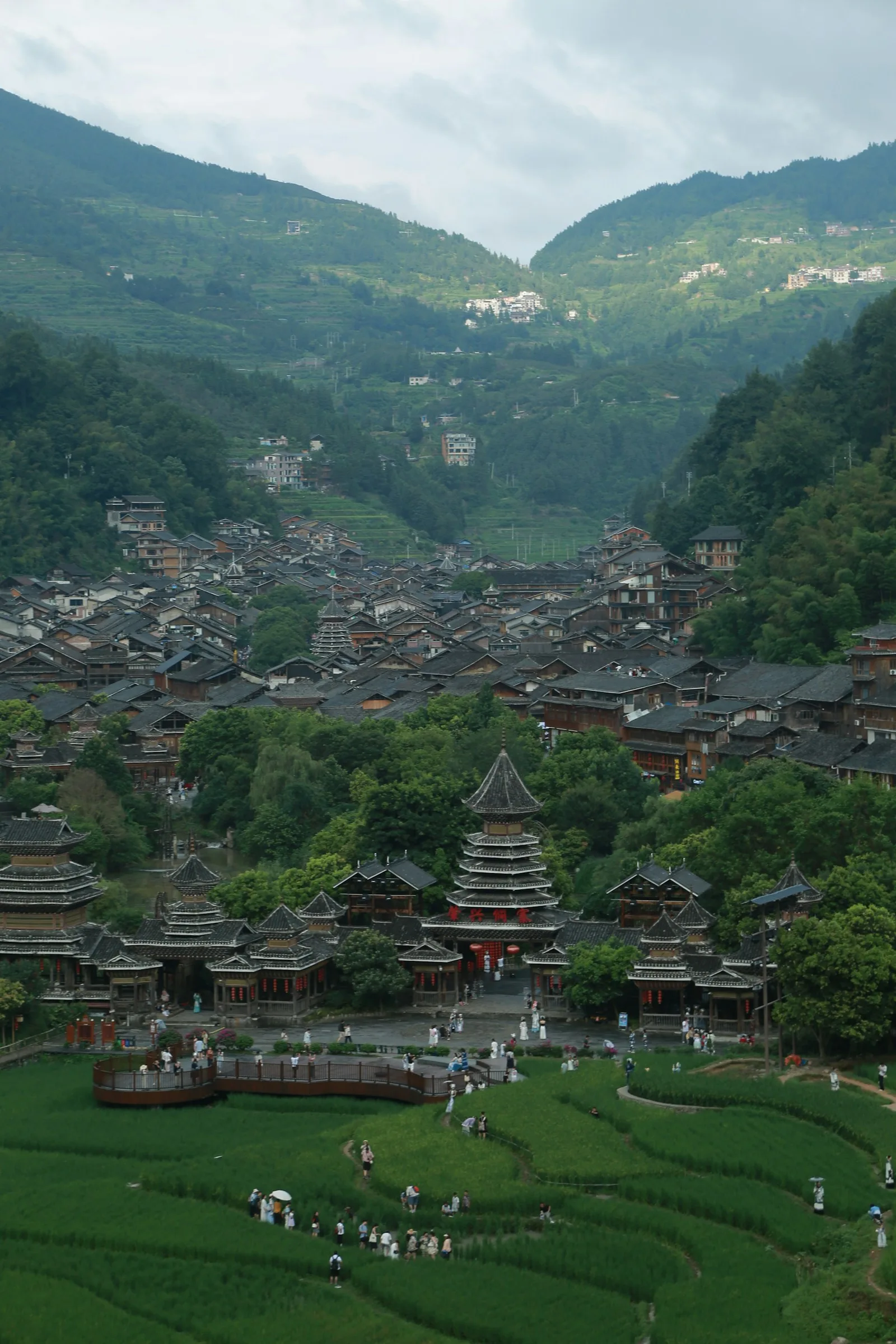
An afternoon inside a Tunbao stone fortress
In a Ming-era garrison village above the Qingshui river, a Buyi caretaker walks us through walls built from riverbed stone and still lived in, four centuries on.
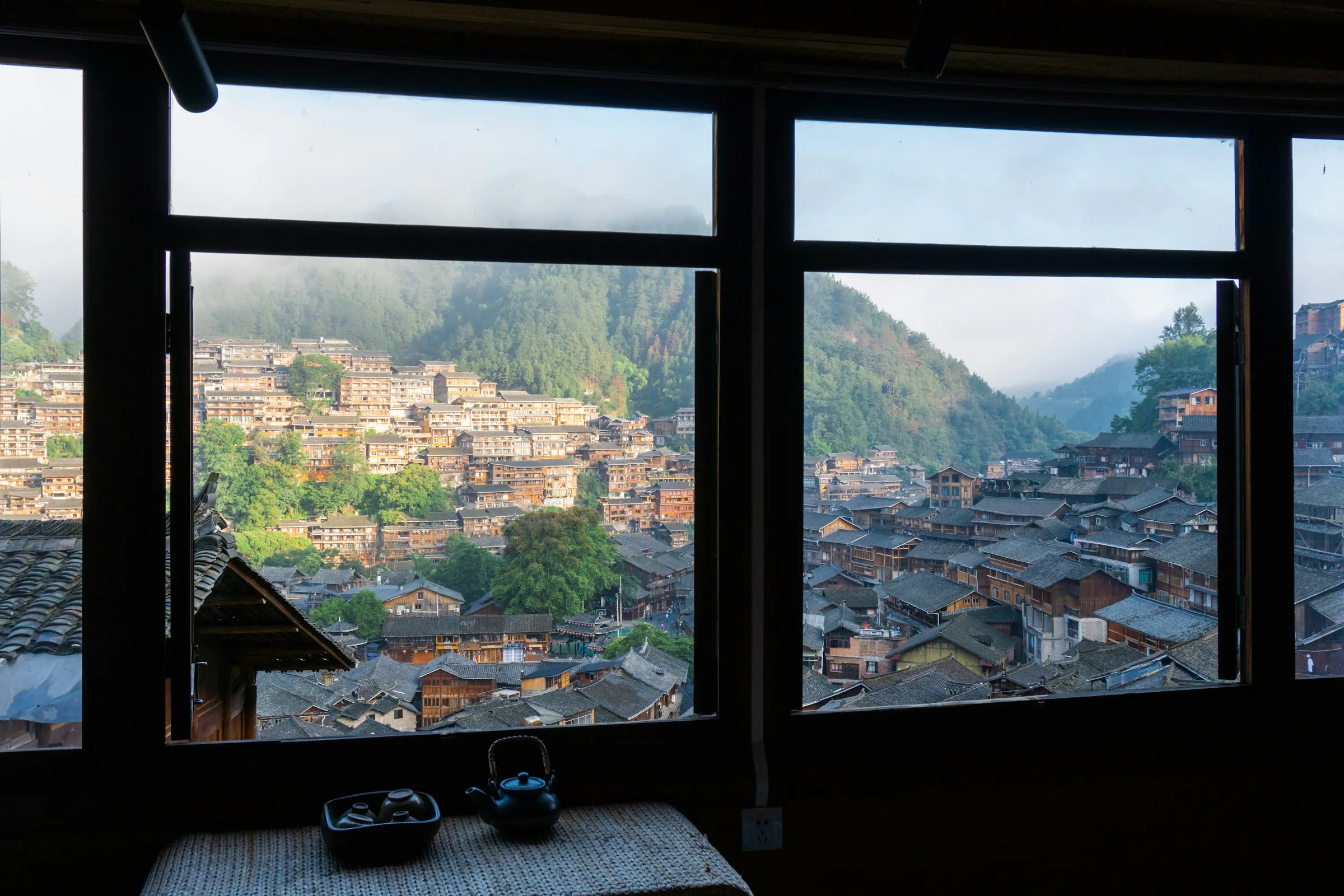
We heard the village before we saw it. From the path above the Qingshui river the sound was the dry, unmistakable clink of a chisel finding a seam in limestone, paused, then finding it again. It carried up the valley in the early afternoon heat without any other sound to share the air, no engine, no dog, only the chisel and somewhere further off the slow knock of a wooden bucket against the lip of a well. Wei Daxiang was waiting for us at the lower gate, a man of sixty-two in a faded blue cotton jacket and rubber-soled cloth shoes, holding a ring of iron keys he did not appear to need. The gate was already open.
The walls of Yunshantun rise straight out of the slope in courses of grey-blue limestone, each block fitted to its neighbour without mortar at the lower courses and with a thin lime wash higher up where the wind works harder. The stones were quarried, Wei told us, from the Qingshui riverbed three hundred metres below in the autumn of 1638, when the water dropped low enough to expose the shelf. Men from the garrison hauled them up the slope on wooden sledges through a winter and a spring. The walls have not been rebuilt since. A few stones near the south corner of the inner courtyard have been re-set, he said, after the 1979 tremor loosened them, but the originals were numbered with a brush in lime and put back in the same order.
We followed him through the lower gate, which is narrow enough that two of us could not pass shoulder to shoulder, and angled so that anyone coming through it has to turn ninety degrees inside the wall before reaching the courtyard. Wei pointed up to the loophole in the inner face, cut at chest height and angled down toward where a body would briefly stand. He did not say more about it. The Ming had a manual for this, he said eventually. The masons knew the manual.
The Tunbao villages along this stretch of the Anshun plain were established as military farms in the late sixteenth century, when the Ming court moved roughly three hundred thousand soldiers and their families into Guizhou to hold the southwestern frontier. The soldiers built fortified hamlets, took up rice and oilseed, and were forbidden to return north. Four centuries later their descendants still hold the land, still speak a Ming-era northern Mandarin that drifts strangely against the local Buyi and Miao dialects, and still wear, on festival days, the wide-sleeved robes their great-great-grandmothers wore.
“More than he could count, he said, and his grandfather could not count them either.”
Wei is Buyi, not Tunpu. His family came down from the karst hills above the village three generations ago when his grandfather married a woman whose family kept a forge inside the fortress wall. He grew up inside these courtyards and learned to read the masonry the way another child might learn to read a face. The Tunpu families still living here number, he said, perhaps forty households. Most of the children have gone to Anshun or Guiyang for work. The old women, who weave and dye the long blue tunics that mark Tunpu women out from any other community in Guizhou, are teaching the craft to two granddaughters who come back in the summer. Two. He said the number without weight.
The central courtyard of the family compound he keeps is paved in the same limestone, worn into shallow dishes by four hundred years of footfall. A stone trough along one wall holds rainwater for the chickens. A bamboo pole strung across the far corner is hung with strips of pork drying in the dry-season air, the fat translucent against the light. Wei lifted the lid of a square stone box set into the courtyard floor and showed us the grain pit below, dry and lined with woven straw, deep enough to hold a winter's rice for ten people. The pit has been emptied and re-lined every autumn since the courtyard was laid. He could not say how many autumns. More than he could count, he said, and his grandfather could not count them either.
The roof above us was slate, each piece split by hand from a quarry one ridge to the east and laid in overlapping rows held by their own weight. No nails, no battens. A slate roof in this country lasts roughly a hundred and twenty years before the lower courses begin to slide, Wei said, and then a mason comes and re-lays them and the count starts again. The current roof was re-laid in 1994. He was the apprentice that summer. He pointed to a slightly darker patch above the kitchen door and said he had cut that one himself, badly, and the master had let him keep it there as a reminder.
We sat with him at the well in the late afternoon. The well is the original Ming well, sunk through six metres of weathered limestone to a small aquifer that has not failed in living memory. The wooden bucket is replaced every fifteen years. The rope is replaced more often. A woman of perhaps seventy came down the lane in a blue tunic and a silver hairpin and drew up a bucket without acknowledging us, then walked back the way she came. Wei said her name and a small fact about her husband, who had died the winter before last, and then he was quiet for a long time.
We asked what would happen to the fortress when the last of the old families left. He thought about it and did not answer directly. He said the county had come three years ago with a plan for a museum and a ticket booth at the lower gate, and the village had said no, and the county had gone away. He said two of the younger families had begun to take in guests for a night or two, with the elders' agreement, and that this seemed to be working. He said the stones did not require very much. They required that someone keep the rain out of the grain pit and the chickens out of the well. The rest, he said, the stones could do for themselves a while longer.
The sun went behind the western wall a little after five. The courtyard cooled almost at once and the smell of woodsmoke from the kitchen on the far side of the compound came across the stones with the precision of a bell. Wei stood up, brushed the back of his trousers with one hand, and walked us toward the upper gate without locking anything behind him. At the threshold he stopped and pointed to a small character cut into the stone of the lintel, a single brush-stroke chiselled by a soldier-mason in the fifteenth year of the Chongzhen reign. The character was an, peace. He ran his thumb across it once, the way a person might touch the corner of a photograph, and stepped out into the lane.
— ArtoEast
We design residencies, faculty-led programmes, and curated delegations around exactly this kind of work.
For universities, museums, cultural institutions, and other groups serious about understanding China at the level the essay above describes.
Programmes are designed bespoke. Tell us who is coming and what they are hoping to understand — we propose from there.
Start a conversation