ArtoEast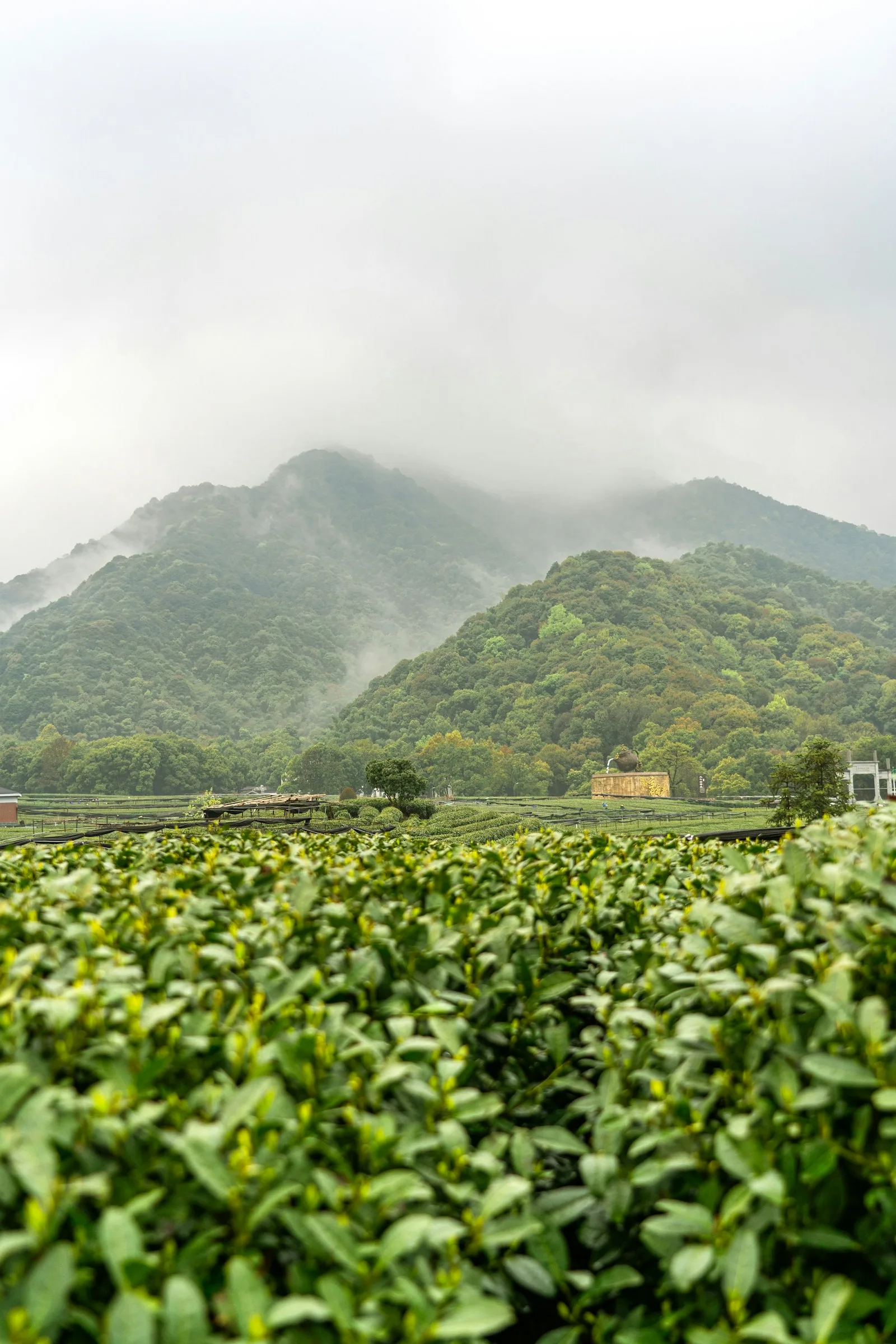
A morning with an Anji baicha grower in the cloud
On a cold April hillside in northern Zhejiang, a third-generation grower walks us through the pale-leaf bushes that anchor a family register older than the road below.
The first thing we heard, climbing the cement track at a quarter past five, was the sound of a bamboo rake being dragged once across a drying-floor somewhere above us in the cloud. Then nothing for a long minute, then the rake again, dragged the other way. We could not see the floor. We could barely see the row of tea bushes immediately to our right, which had been pruned the autumn before to chest height and stood now as a low grey-green wall along the contour. The air smelled of cold stone, of last night's rain on bamboo, and of something faintly sweet that was not yet the leaf itself but the soil under the leaf, woken by the wet. Tang Jianping was somewhere above us, drinking his second tea of the morning, waiting.
We were three days into the picking season. Anji county sits in the north of Zhejiang, an hour and a half west of Hangzhou by car, in a fold of low mountains where the bamboo forest still covers more ground than anything cultivated. The road from the county seat had wound through stands of moso so tall the headlights had not reached the canopy. Then the road had narrowed to a track, and the track had narrowed to a footpath of broken brick laid sometime in the eighties, and somewhere along the footpath the cloud had closed over us.
Mr Tang was waiting in the doorway of a single-room building of plaster and tile that sat on the lower edge of the family garden. He is fifty-four. He inherited the garden from his father, who had inherited it from a paternal uncle, and the uncle had been given the original cuttings, sometime in the late seventies, from the now-famous mother bush on the slope of Tianhuangping, the one the county records call Bai Cha Zu, the white tea ancestor. That bush, found by a forestry surveyor in 1930 and propagated only after 1981, carries a genetic variant that suppresses chlorophyll for the first weeks of spring. The new leaf comes in pale, almost yellow, and only later in the season turns green.
We asked him what the variant was called. He shrugged. The leaf is white, he said, and that is what we call it.
“The leaves at the tips of the new shoots were the colour of fresh bamboo shoot, almost translucent at the edge, with a fine raised vein running the length.”
The bushes we were about to pick were forty-one years old, set in narrow terraces no wider than a man's reach, on a south-east-facing shoulder that caught the first sun once the cloud lifted. The leaves at the tips of the new shoots were the colour of fresh bamboo shoot, almost translucent at the edge, with a fine raised vein running the length. He held one between thumb and finger and turned it for us in the grey light. A leaf that did not know yet, he said, that it was supposed to be green.
We walked with him along the top terrace. He moved slowly and picked without bending his back, the work done from the elbow, a bud and a single leaf taken with the nail of his thumb against the pad of his index finger and dropped into a small cotton bag at his hip. He did not look down. He looked, instead, at the next bush along the row. His wife had begun on the lower terrace and was working upward toward him at roughly the same pace, the way two people sweeping a courtyard work toward the middle. They did not speak.
Anji baicha sits awkwardly inside the Chinese tea cabinet. By processing it is a green tea, fired in a wok like Longjing, rolled flat, brewed at eighty degrees in a tall glass. By colour and by amino-acid profile it behaves like something else entirely. The pale leaf carries roughly twice the theanine of an ordinary spring green, which is what gives the cup the soft, almost broth-like sweetness that the county sells itself on. The window for that sweetness is short. Once the leaf greens, around the first week of May, the chemistry shifts and the bushes give an ordinary, perfectly decent tea that no one writes home about. The family lives, Mr Tang said, on three weeks of work.
By nine the bag at his hip was perhaps a third full and the cloud had thinned enough that the bamboo forest on the next ridge had begun to show. We followed him down to the firing room. His son Tang Wei, twenty-eight, had a flat-bottomed electric wok already at temperature against the back wall and a second wok, gas-fired, beside it. The leaves went into the first wok in handfuls of perhaps four hundred grams. The son worked them with bare palms, lifting and folding, the wrist doing the small turning motion that flattens the leaf without crushing the vein. He had no thermometer. He had a wrist, and he had his father standing two steps behind him with a cup of last year's tea, not watching, exactly, but present.
The smell that rose from the wok in the first minute was the smell of cut grass after rain. By the third minute it had narrowed to something closer to fresh chestnut, and by the fifth a sweetness arrived at the back of the room that we could only describe, later, as the smell of a bamboo grove on a warm afternoon. Tang Wei tipped the leaves out onto a bamboo tray and stood with the back of his hand against the wok's rim, judging whether to send the next batch in hot or let the surface cool a quarter minute.
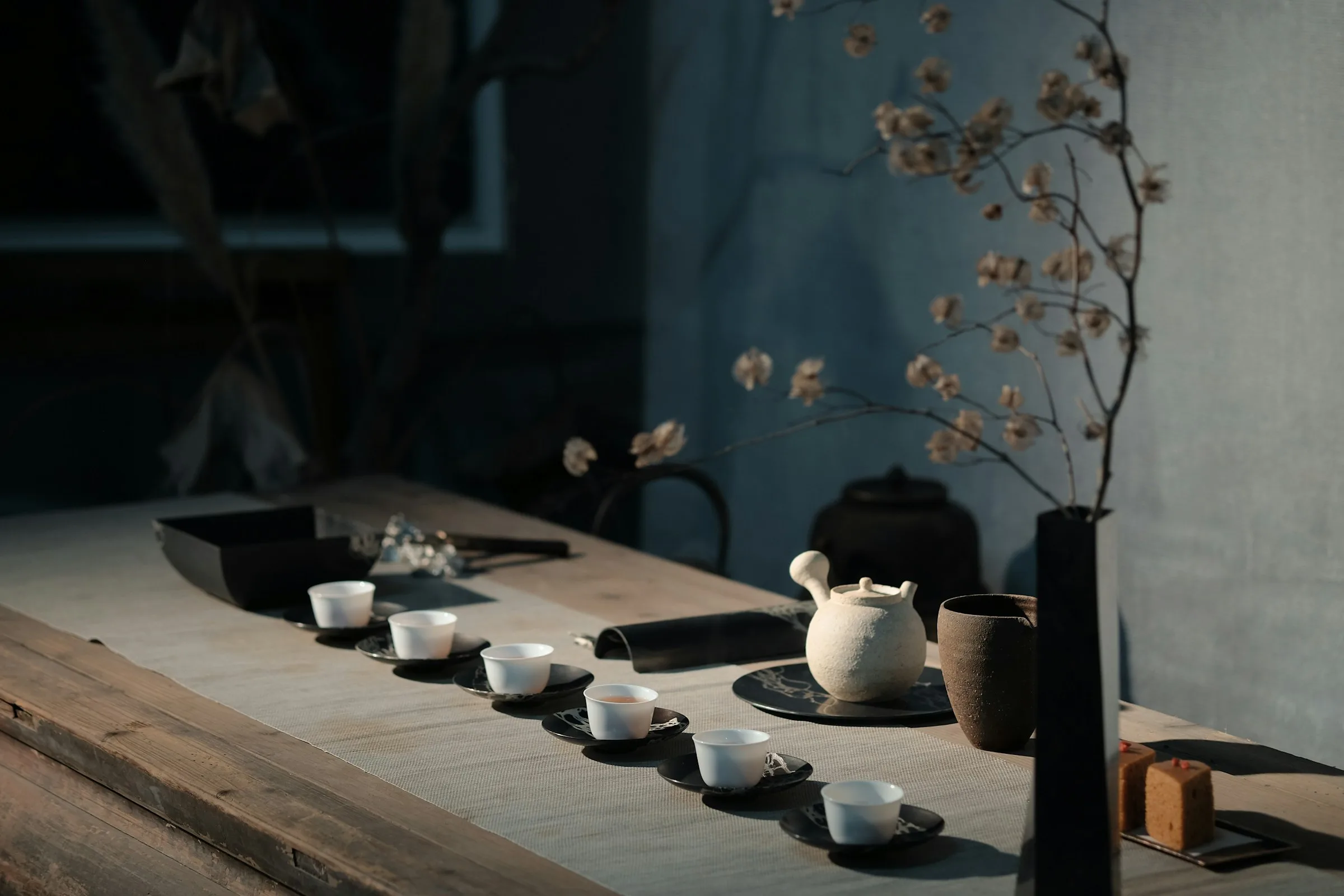
A little after eleven Mr Tang weighed three grams of the morning's first finished leaf into a tall glass and poured water from a kettle that had come off the boil three minutes before. The leaves opened slowly and stood on end, the pale spine catching the light, and the liquor came up the colour of the inside of a young bamboo, almost colourless against the white windowsill behind. He set the glass on the table between us and went back to the wok.
The first sip was almost nothing. Warmth, a faint vegetal note, and then a slow returning sweetness at the soft palate that arrived a count or two after we had swallowed, cool and round and faintly of something we eventually agreed sounded like fresh sugarcane. The second sip was the same and longer. The third sip was the same and longer still. We drank without speaking. Mr Tang refilled the glass from a small thermos. Outside, the cloud had lifted off the lower bamboo and the light on the wet tile of the firing-room roof was the pale clean light Zhejiang gets in early April. He set the lid back on the thermos and went to weigh out the next batch.
— ArtoEast
We design residencies, faculty-led programmes, and curated delegations around exactly this kind of work.
For universities, museums, cultural institutions, and other groups serious about understanding China at the level the essay above describes.
Programmes are designed bespoke. Tell us who is coming and what they are hoping to understand — we propose from there.
Start a conversation