ArtoEast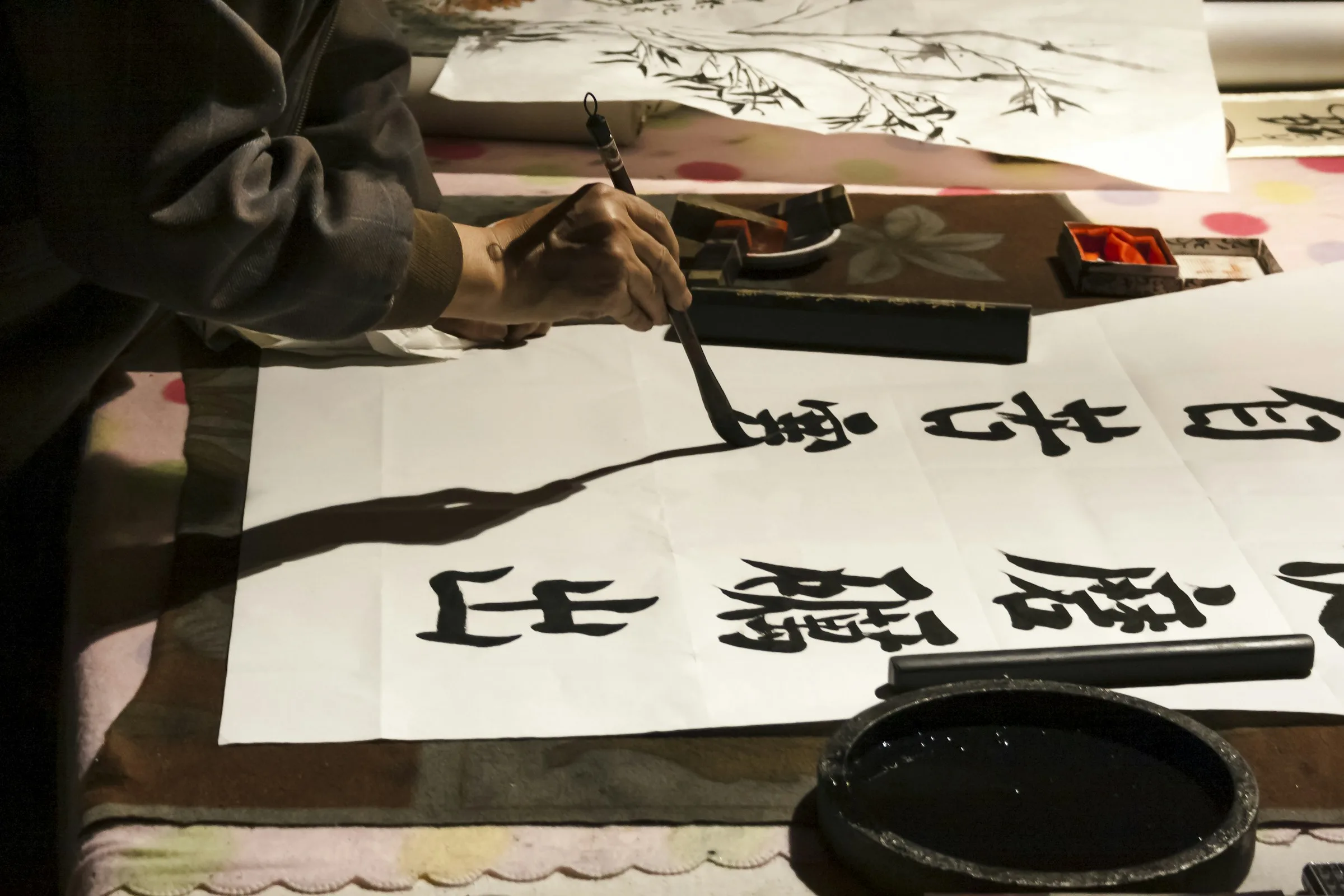
An Afternoon with a Hangzhou Calligrapher
An afternoon in a Pinghu Lane studio near West Lake, where a wolf-hair brush, a single character, and the rhythm of breath ask a different kind of attention.
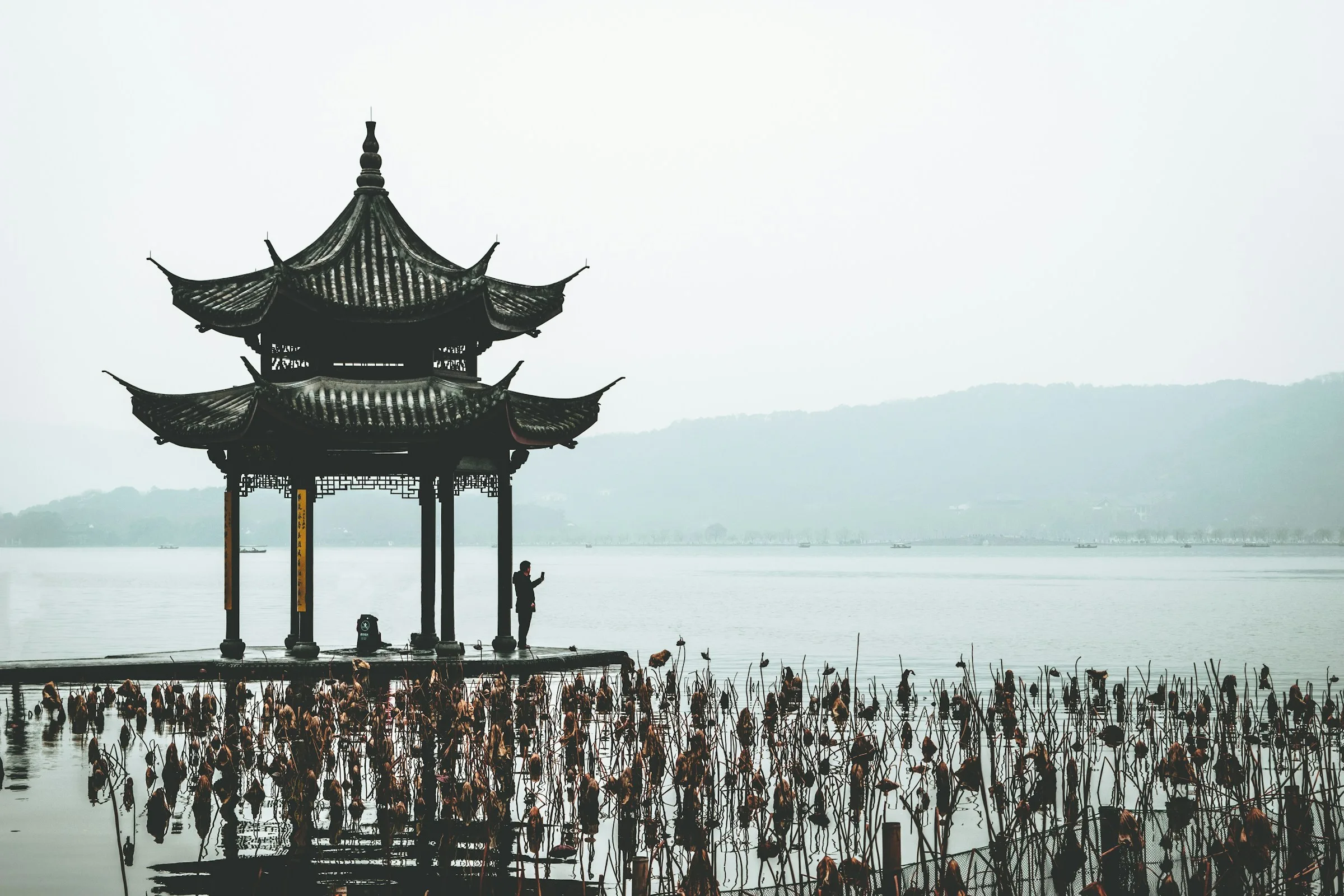
The kettle on the windowsill begins to tick before the water boils, and Master Shen lifts it off the gas ring without looking up. He is grinding ink on a She stone the colour of a wet roof tile, holding the pine-soot stick at a slight angle, drawing slow circles with water he poured from a porcelain cup ten minutes ago. The sound is small and dry, like a moth against paper. We have been in his studio on Pinghu Lane for forty minutes and he has not yet asked our names. The lane outside runs three blocks back from the eastern shore of West Lake, narrow enough that a delivery scooter passing the door makes the window-frames shiver.
The studio occupies the ground floor of a two-storey house his grandfather bought in 1948. A long table runs the length of the room, covered in felt the colour of old moss. Brushes hang above it from a horizontal bamboo rod, twenty-three of them, sorted by the animal the hair came from: goat, weasel, rabbit, horse, and at the far right a single wolf-hair brush bound in goose-quill, its handle darkened from sixty years of his father's grip and now his. He tells us this brush will be used today. He says it the way someone might mention which knife will cut the fish.
The character he sets before us is wu (無) — not, nothing, without. He writes it once on a sheet of practice paper, in the running script lineage that traces back to Wang Xizhi's Lanting Xu, the Orchid Pavilion preface of 353 CE, which every calligrapher in this room's tradition has copied at least a thousand times. The character has twelve strokes when written in the older form he prefers. He writes it again. Then he hands us the brush and asks us to write it. We will write it, he says, perhaps fifty times this afternoon, and we will keep none of them.
His two students arrive at the half-hour. Wang Lin is nineteen, in her second year at the Hangzhou Conservatory's calligraphy programme, wearing a grey linen jacket and carrying a thermos. The other is Mei, mid-thirties, who quit a software engineering post at a company three metro stops away eight months ago. She does not explain the decision and Master Shen does not press it. They take their places at the far end of the table without ceremony. The cat, an elderly tortoiseshell named Mo (墨, ink), settles on the chair Mei pulls out, and Mei sits on the chair next to it instead.
Master Shen speaks about breath before he speaks about the brush. The stroke begins, he says, not at the paper but at the base of the lungs. A character written while holding the breath looks frightened. A character written while exhaling at the wrong moment splinters at the end of the horizontal. He demonstrates: inhales through the nose for a count we cannot measure, lowers the wolf-hair tip until it kisses the paper, and draws the first stroke of wu on a long exhale that ends a fraction of a second after the brush lifts. The line has weight at its beginning and a tapered release like a held note resolving.
“A character on paper, written with ink, cannot be revised. The one you wrote is the one you wrote.”
We try. Our first wu looks like a fence in a strong wind. Wang Lin glances over, polite, and returns to her own sheet, where she is copying a Tang dynasty fragment in regular script, each character sitting inside an invisible square. Mei is working on the same character we are, wu, but her hand is steadier. She has been at this for eight months and her strokes have the quality of someone who has stopped asking the brush to behave. Master Shen walks behind us, says nothing for a long time, then taps the table once beside our paper and says: again, but this time do not try to make it good.
Around eleven he stops the work and makes tea. The leaves are Longjing from the first picking this April, gathered before Qingming from the slopes above Meijiawu village fifteen kilometres west. He pours hot water into a glass tumbler and the leaves stand upright before sinking. The tea tastes of new grass and a faint chestnut sweetness at the back of the throat. Mo the cat wakes up, considers us, and goes back to sleep. Through the open door we can hear a woman calling her son in for lunch in the Hangzhou dialect, the vowels softer and more rounded than the Mandarin we have been trying to use all morning.
We ask Master Shen, over the second cup, whether he worries that screens will eventually eat brush practice. He thinks about it for the length of time it takes the steam to stop rising from the tumbler. The screen, he says, lets you revise. That is its gift and its problem. A character on paper, written with ink, cannot be revised. You can throw the sheet away and write another, but the one you wrote is the one you wrote. He gestures at Mei without looking at her. She came back to this, he says, because she had spent six years writing things that could always be changed. We do not press him further.
The afternoon settles into a rhythm we did not choose and cannot accelerate. Wu again. Wu again. The thirty-first attempt is worse than the twenty-ninth. The thirty-fourth surprises us — the central vertical holds its weight, the four dots at the base land in something like the right relationship to each other. Master Shen passes behind, does not stop, does not comment. Wang Lin has moved on to a different fragment. Mei is still on wu. The lane outside has gone quiet; it is the hour between lunch and the school run when Hangzhou's back streets exhale.
Somewhere around the forty-third wu we begin to understand what the lesson is not about. It is not about producing a character anyone would frame. It is not about mastery, which is decades away and arguably not the point. It is about the fact that each stroke commits, and the commitment is the practice. We write the character knowing it cannot be unmade, and so we are obliged to be present to the making of it, which is a different quality of attention than almost anything else in the day asks of us.
At four o'clock Master Shen takes the brush back and writes wu one final time on a fresh sheet, the wolf-hair tip moving in a way ours has not all afternoon. He sets the sheet on the table and walks to the kettle. He does not give it to us. Wang Lin and Mei begin to clean their brushes in a small porcelain basin, working the ink out with their fingers until the water runs grey, then almost clear. We are invited to do the same. The wolf-hair brush is cleaned last, by Master Shen himself, and hung back on the bamboo rod.
Walking back along the lane toward the lake, the light low and the willows along the Bai Causeway gone the colour of old brass, we think about the fifty sheets of paper we wrote on this afternoon, none of which we kept. Master Shen told us at the door, almost as an afterthought, that the studio holds open afternoons on the first Saturday of each month and that Mei sometimes teaches the introductory session now. We did not ask whether we should come back. We suspect the answer to that question is the same as the answer to most questions he was asked today, which is to say, he would let us decide.
— ArtoEast
Photography by Marco Zuppone via Unsplash.
We design residencies, faculty-led programmes, and curated delegations around exactly this kind of work.
For universities, museums, cultural institutions, and other groups serious about understanding China at the level the essay above describes.
Programmes are designed bespoke. Tell us who is coming and what they are hoping to understand — we propose from there.
Start a conversation