ArtoEast
A Shapowei sound studio recording across the strait
A Thursday session in a converted Xiamen warehouse, where a Taiwanese songwriter and a Hokkien-singing engineer chase a vocal take that holds two coastlines at once.
The first thing we heard, before any voice or instrument, was the low hum of the air-handler kicking down as the live room door sealed behind us. Then the soft tap of a finger against a condenser mic head, then the rustle of a paper lyric sheet being smoothed flat on a music stand. Lin Zhihao, the engineer, was crouched behind a patch bay at the back wall, sleeves pushed to the elbow, running a fresh XLR through a panel marked in Hokkien shorthand he had written in pencil sometime around 2019. He did not look up. He was counting cable returns, and the count mattered more than the introduction.
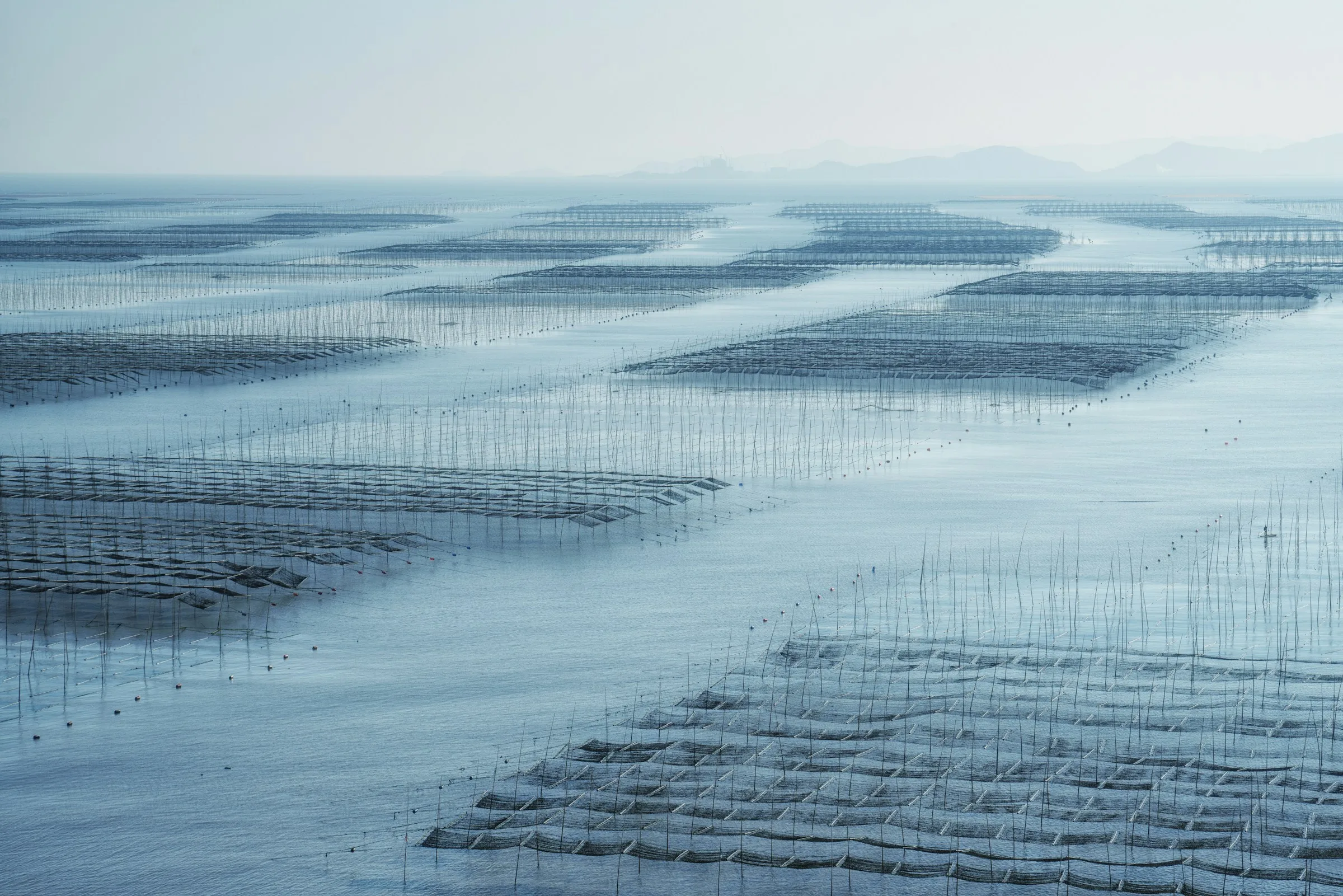
Shapowei sits at the southern edge of Xiamen island, a horseshoe of low warehouses and oyster-drying yards wrapped around a working fishing harbour that, until the early 2010s, was scheduled for demolition. The municipality reversed the order, the warehouses stayed, and over the following decade a slow accretion of design studios, small bars, ceramic workshops and recording rooms moved into the disused storage halls along Yuxin Road. Lin's studio, called Hai Fang, occupies the rear two-thirds of a former net repair shed, two storeys of brick and weathered fir, the rafters still hung with the iron hooks the menders used. The control room faces the water. From the window, on a clear afternoon, we could see the outline of Kinmen across the channel, the Taiwanese island that has been the practical horizon of Lin's working life since he opened the room in 2017.
Lin is forty-three. He grew up in Zhangzhou, an hour west, in a household where his father played yueqin in a Gezai opera troupe and his mother kept the troupe's accounts in a brown ledger. He went to Beijing for sound engineering school, worked five years in a commercial post-production house cutting advertising beds, and came home in 2016 with the savings from those five years and a specific question. The question was whether a room could be built on this coast that would record Hokkien-language singers and the Mandarin-language collaborators who increasingly wanted to work with them, without flattening either voice into the register of the mainland pop circuit.
The console is a forty-channel SSL, second-hand, shipped down from a closed studio in Shenzhen and rebuilt by a technician Lin knows in Taipei. He talks about it the way other craftspeople talk about a kiln. The faders, he said, run slightly heavy on the left bank, and he has learned to ride them accordingly. Beside the console sits a much older piece of equipment, a Studer tape machine from the late 1970s that belonged to a recording engineer in Kaohsiung who emigrated to Vancouver in 1990 and sold the machine back, years later, to the family of a friend, who sold it on to Lin. He uses it perhaps twice a month, when a singer wants the particular soft compression that only quarter-inch tape gives to a sustained vowel. The reels he keeps in a cabinet labelled in two scripts.
“She had written a song in mixed Taiwanese Hokkien and Mandarin about her grandmother's village on the Fujian coast, which she had visited for the first time in 2024.”
The session that afternoon was for a singer named Chen Yuting, twenty-eight, who had come over from Tainan three days earlier on the small-craft ferry that runs from Kinmen to Xiamen. She had written a song in mixed Taiwanese Hokkien and Mandarin about her grandmother's village on the Fujian coast, which she had visited for the first time in 2024. The arrangement, sketched by a Xiamen-based guzheng player called Wang Liyan, sat the vocal between a low drone of bowed bass and a sparse line of plucked strings. Chen had asked Lin specifically because she wanted the consonants of the Hokkien lines to sit forward in the mix the way her grandmother spoke them, hard and slightly nasal, without the polish that a Taipei pop engineer would have instinctively reached for.
We sat in the control room through the first three takes. Lin worked the console with his right hand and a paper notebook with his left, marking each take with a small character in the margin that, he said when we asked, was shorthand for how the vowel had landed. There were four possible characters. He would not tell us what they meant. After the third take he leaned to the talkback and said something in Hokkien that we did not catch but that made Chen laugh in the live room and shake out her shoulders. The fourth take was the one. The held vowel at the end of the second verse, an open ah on the word for sea, sat in the room for perhaps eleven seconds, fraying very slowly at the edges, and Lin closed his eyes through the whole of it.
Wang Liyan arrived around four with the guzheng in a soft case and a thermos of tea. She is from Quanzhou, two hours up the coast, and trained at the conservatory in Shanghai before moving back south in 2020. The conversation in the control room shifted, without announcement, into a working trilingual mix of Mandarin, Hokkien and the technical English that recording rooms everywhere share. Wang and Chen had not met before that week. They worked through the guzheng line phrase by phrase, Chen humming the vocal under her breath while Wang tried two different fingerings against it, neither speaking much, both listening for the place where the instrument would step back and let the consonants through.
Cross-strait collaboration, when described from a distance, tends to be flattened into a political abstraction. Inside the room it is a working condition with practical details. Chen had brought her own preferred reverb plate setting, sketched on the back of a receipt from a coffee shop in Tainan, and Lin worked from it as a starting point and then drifted. Wang's guzheng was strung with a particular nylon-wound treble set that she sources from a maker in Yangzhou; the boxes of spare strings she carries through customs each trip sit in a drawer in Lin's office. The lyric sheet on Chen's music stand was printed in both traditional and simplified characters, line by line in parallel, so that whichever script she had drafted a phrase in first remained legible to whichever collaborator she was reading it to. None of this is remarkable to the people doing it. It is simply how the work proceeds.
We asked Lin, in a pause between takes, whether the sessions had changed shape since he opened the room. He thought for a while. The early years, he said, had been mostly his own circle, friends from Zhangzhou and Beijing recording small projects on borrowed weekends. After 2019 the mix shifted. Producers in Taipei began sending singers across when a project called for a Fujian sensibility in the vocal; mainland labels began routing certain Hokkien-language tracks through the room specifically because Lin would not sand the dialect out of them. The room earns its rent, he said, partly because it is a room where two registers are allowed to stay themselves and still arrive in the same mix.
By half past seven the last pass was on disk and the live room had gone quiet. Lin laid a microfibre cloth over the condenser, the way you might cover a dish, and walked us out along the harbour path. The oyster sheds across the water were lit by single bare bulbs, and the small ferry from Gulangyu was crossing the channel for its last run. Chen and Wang had gone ahead to a noodle stand at the far end of Yuxin Road. Lin stood for a moment at the rail. He said, without looking at us, that the room was busy enough now that he had stopped worrying about the calendar, and that what he listened for at the end of a session was not whether the take was correct but whether the vowel had stayed in the room long enough for both coastlines to recognise it. Then he locked the door behind us, and we walked toward the noodle smoke at the end of the road.
— ArtoEast
We design residencies, faculty-led programmes, and curated delegations around exactly this kind of work.
For universities, museums, cultural institutions, and other groups serious about understanding China at the level the essay above describes.
Programmes are designed bespoke. Tell us who is coming and what they are hoping to understand — we propose from there.
Start a conversation