ArtoEast
A week with a Wuyi rock-tea roaster
Notes from Tongmu village, where a fourth-generation roaster works bamboo baskets and oak charcoal across six slow months to find the cliffs in the cup.
The kettle had been boiling for the third time when Lao Chen finally turned from the window. We had been sitting on low wooden stools in his roasting shed at the edge of Tongmu village, watching the mist climb the gorge in slow vertical columns, and he had said almost nothing for forty minutes. Then he reached for a small porcelain gaiwan, rinsed it twice with water that smelled faintly of pine smoke, and laid out three rolled, almost black leaves of last spring's Da Hong Pao. He did not announce the tea. He simply set the cup in front of us and waited.
Tongmu sits at around 1,100 metres inside the Wuyishan reserve in northern Fujian, a cluster of stone-and-timber houses pressed against a stream the colour of weak jade. The road in is single lane and signed in three scripts. We had come to sit with Lao Chen, a fifty-eight-year-old roaster in the fourth generation of his family to work yancha, the rock teas of these cliffs. His grandfather, he told us later, had worked the same baskets through the lean years of the 1960s, when the bushes were almost lost to grain quotas. The baskets, woven from local mao bamboo, were patched but original.
What the Chinese call yan yun, rock rhyme, is the thing every Wuyi roaster is reaching for and almost no one will define out loud. We had read the phrase translated as mineral aftertaste, as the breath of the cliffs, as a kind of cold sweetness that arrives at the back of the throat several seconds after you swallow. Lao Chen, when we asked, shrugged and pointed at the wall of rock visible through the open door. The bushes, he said, grow from cracks no wider than two fingers. They drink rain that has run over stone for two thousand years. Whatever yan yun is, it begins there, long before any human touches the leaf.
On the second morning we walked with his nephew Xiao Wu up the path toward the Zhengyan core zone, the narrow belt of cliffs where the most prized bushes grow. The climb took an hour. Xiao Wu stopped at a cleft in a vertical face and pointed to four scraggly bushes clinging out of the rock at chest height, their roots invisible inside the stone. These were not the famous mother trees, which sit higher up and have not been picked since 2006, but they were old, perhaps 180 years, and they were tended by a single family who climbed up twice a year with shears and a cloth bag. The leaves picked here in late April had been finished only the week before our arrival.
“Whatever yan yun is, it begins there, long before any human touches the leaf.”
Back in the shed, Lao Chen was preparing the second roasting. The leaves had already been through the spring cycle, withering on bamboo trays in the sun, then bruised by hand along the leaf edge to start oxidation, then fired in a heated wok to halt it, then rolled and dried. That was finished work by most standards. What separated yancha from other oolongs, he said, was what came after: the long, slow roasting over charcoal, sometimes spread across six months, with rests of weeks between each pass. A two-month roast, he told us, gave you a brighter, greener cup that the Cantonese markets liked. A six-month roast turned the leaf almost black and pulled out a deeper, drier register, plum stone, dark caramel, wet slate. He was working toward the longer end this year.
The charcoal itself was a story. It was made from a hardwood the locals call li mu, oak from the mid-slopes, burned down in earth kilns until it was nearly weightless and rang faintly when two pieces were tapped together. A merchant came up from Jian'ou twice a year to deliver it. Lao Chen weighed out roughly nine kilos for the basket we were watching, banked it under a layer of ash so that the heat would rise at sixty to eighty degrees Celsius rather than flame, and lowered the bamboo basket of leaf on top. Then he said, come back in twenty minutes, and walked out to feed the dog.
The silence inside the shed was not theatrical. It was the silence of a process that does not need supervision so much as patience, and of a man who has lived inside that process for forty-three years. We sat. The basket gave off a smell that shifted while we watched it, first vegetal and almost grassy, then sweeter, like baked apple, then, near the end of the pass, a dry mineral edge that I have no better word for than stone. When Lao Chen returned he lifted the basket with both hands, judged the leaf by colour and by some test of the wrist, and set it aside on a rack to rest. The next firing, he said, would be in eleven days.
Over lunch, his wife Mei brought out bowls of bamboo shoot soup and a plate of smoked river fish, and the conversation turned to what was changing. The reserve rules had tightened since 2017. Some of the smaller roasters had moved out of the core zone to villages downstream, where regulations were lighter and electric roasters were permitted. Lao Chen's son worked in Xiamen as a software engineer and visited at New Year. Whether the son would come back to take the baskets was, Mei said while ladling, a question they had stopped asking out loud. The grandson, who was nine, liked to sit in the shed and was allowed to turn the leaves once they had cooled.
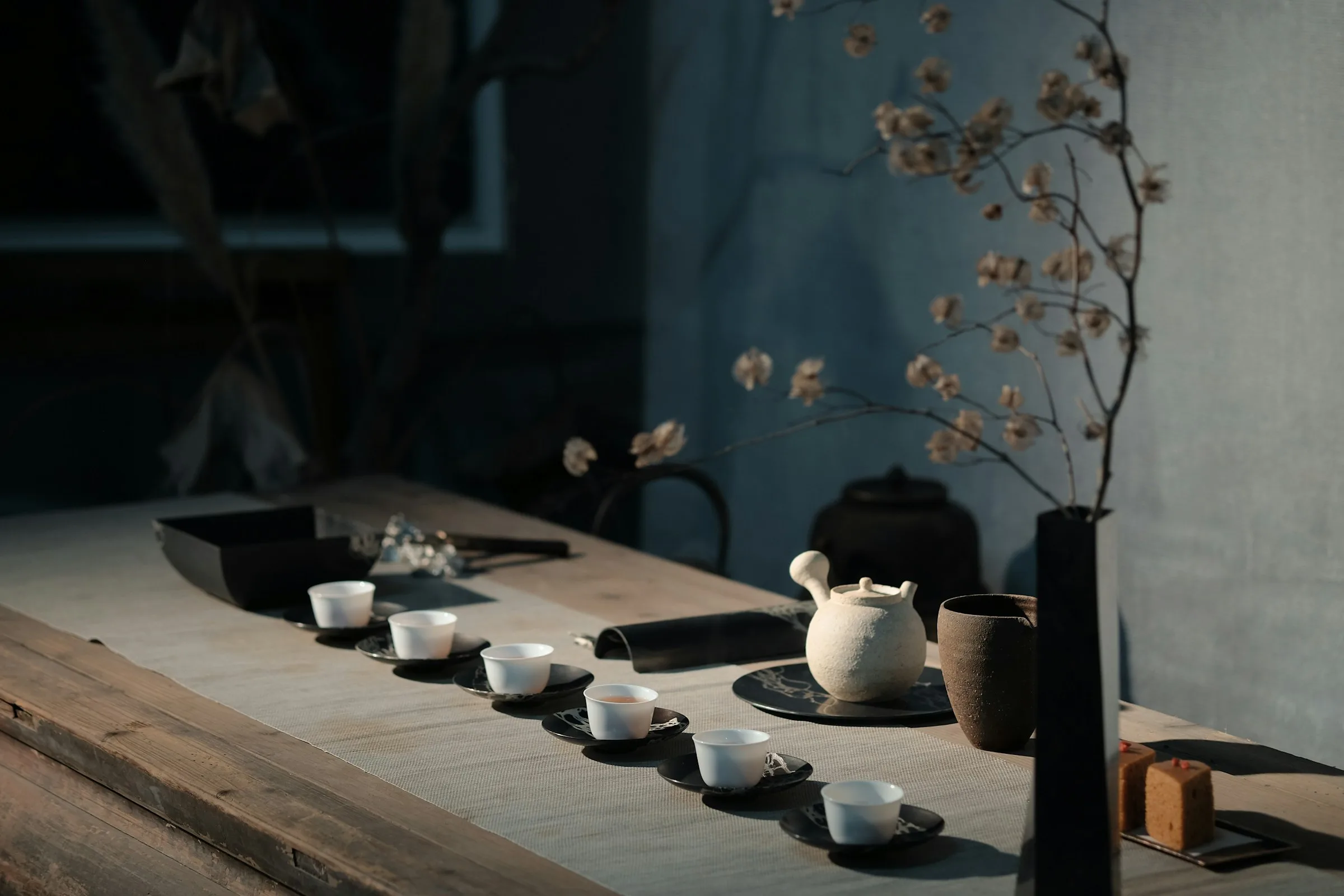
On the third day we attended a tasting in the back room, a low table set with five gaiwans and a kettle of spring water that Lao Chen drew himself from a source above the village. He brewed each of his roasts in sequence, the two-month first, then a three, a four, the long six-month at the end. The differences were not subtle. The early roast tasted of orchid and warm bread. The six-month cup was darker and quieter and arrived in two parts, a body of dried fruit and then, after a pause of perhaps eight seconds, a returning coolness at the soft palate that tasted, genuinely, of moss and stone. This, Lao Chen said, was the cup his grandfather had been chasing. He did not smile when he said it. He simply refilled the gaiwan and waited again.
We asked, on the last morning, what the work felt like from inside. He thought for a long time. The leaves, he said, are not really yours. They come from the rock, and the rock has been here longer than any family. A roaster's job is to listen to what the leaf is doing in the basket and to not get in its way. Most of his mistakes, he said, had been from impatience, from trying to push the fire when the leaf was not ready. He gestured at the row of finished tins along the wall, each labelled in his own brush in a slightly tilted hand. Some years, he said, you understand what the cliff is saying. Some years you do not.
The bus back to Wuyishan station left at half past two. Mei pressed a small foil packet into our hands as we stood by the gate, three grams of the long roast, enough for one careful brewing at home. Lao Chen lifted a palm from the doorway and went back inside to feed the next basket. The mist had not lifted all week. Somewhere above us, on a ledge we could not see, the four bushes were standing in their crack in the rock, and the rain that had fallen the night before was already running down through stone toward roots two centuries old. We carried the packet down the path in silence, and tried, for once, not to speak about what we had drunk.
— ArtoEast
We design residencies, faculty-led programmes, and curated delegations around exactly this kind of work.
For universities, museums, cultural institutions, and other groups serious about understanding China at the level the essay above describes.
Programmes are designed bespoke. Tell us who is coming and what they are hoping to understand — we propose from there.
Start a conversation