ArtoEast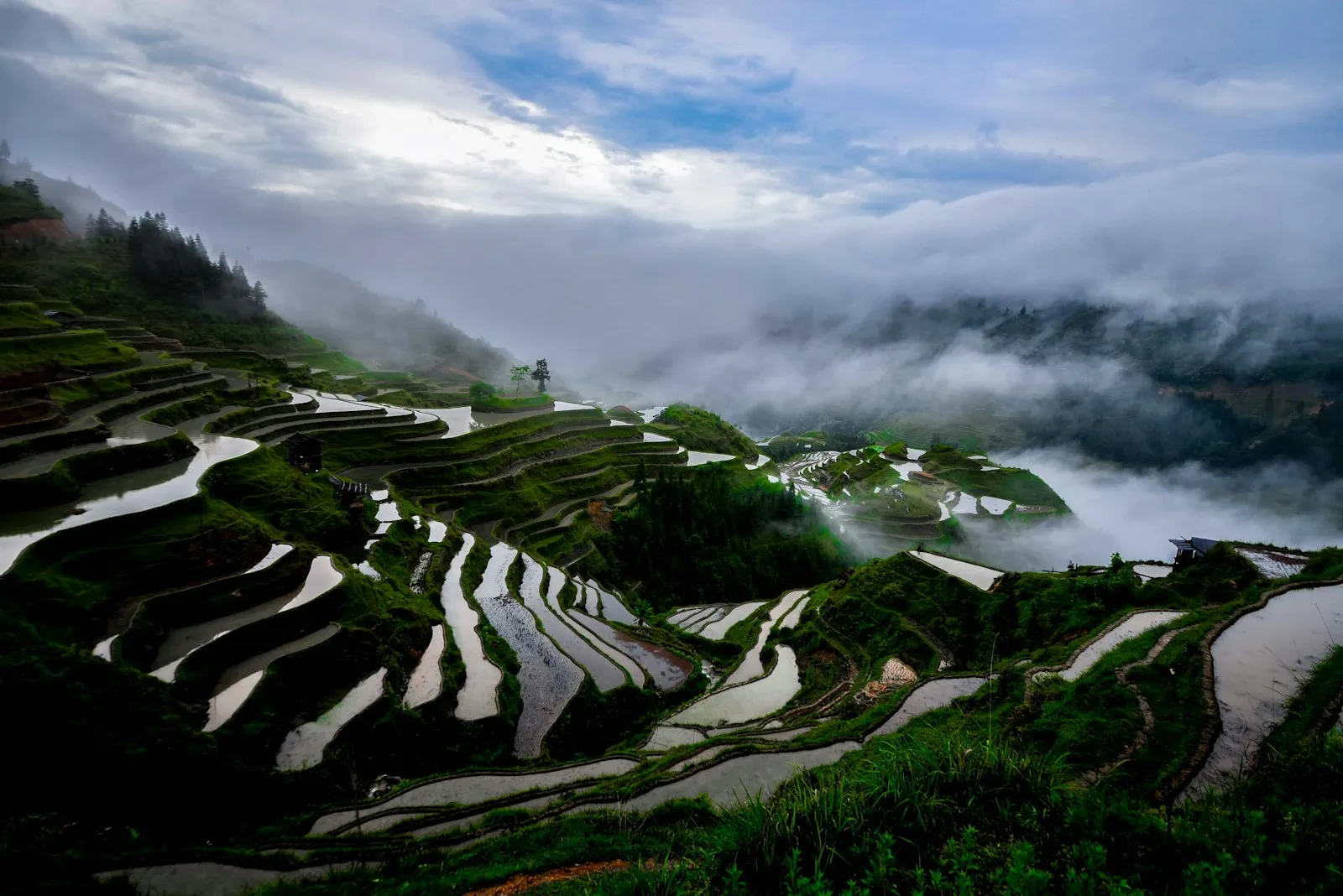
Indigo paper in a Miao courtyard above the Qingshui River
In a seventh-generation Miao collective above the Qingshui River, mulberry-bark paper is hand-pressed and indigo-dyed for festival banners, granary cuttings, and a French conservator's annual order.
The lane up to the workshop in Shiqiao is steep and slick from a night of rain, and we smell the paper before we see it — a green, leafy weight in the air, somewhere between cut grass and pond water, with a metallic edge underneath that we will later learn is the indigo. Pan Yuhua is waiting at the gate with her father and a thermos. She is forty-one, runs the family collective with her two younger cousins, and her hands, when she takes ours, are stained the same deep blue we have already smelled. The stain stops cleanly at the wrist, as though painted on. It is not painted on.
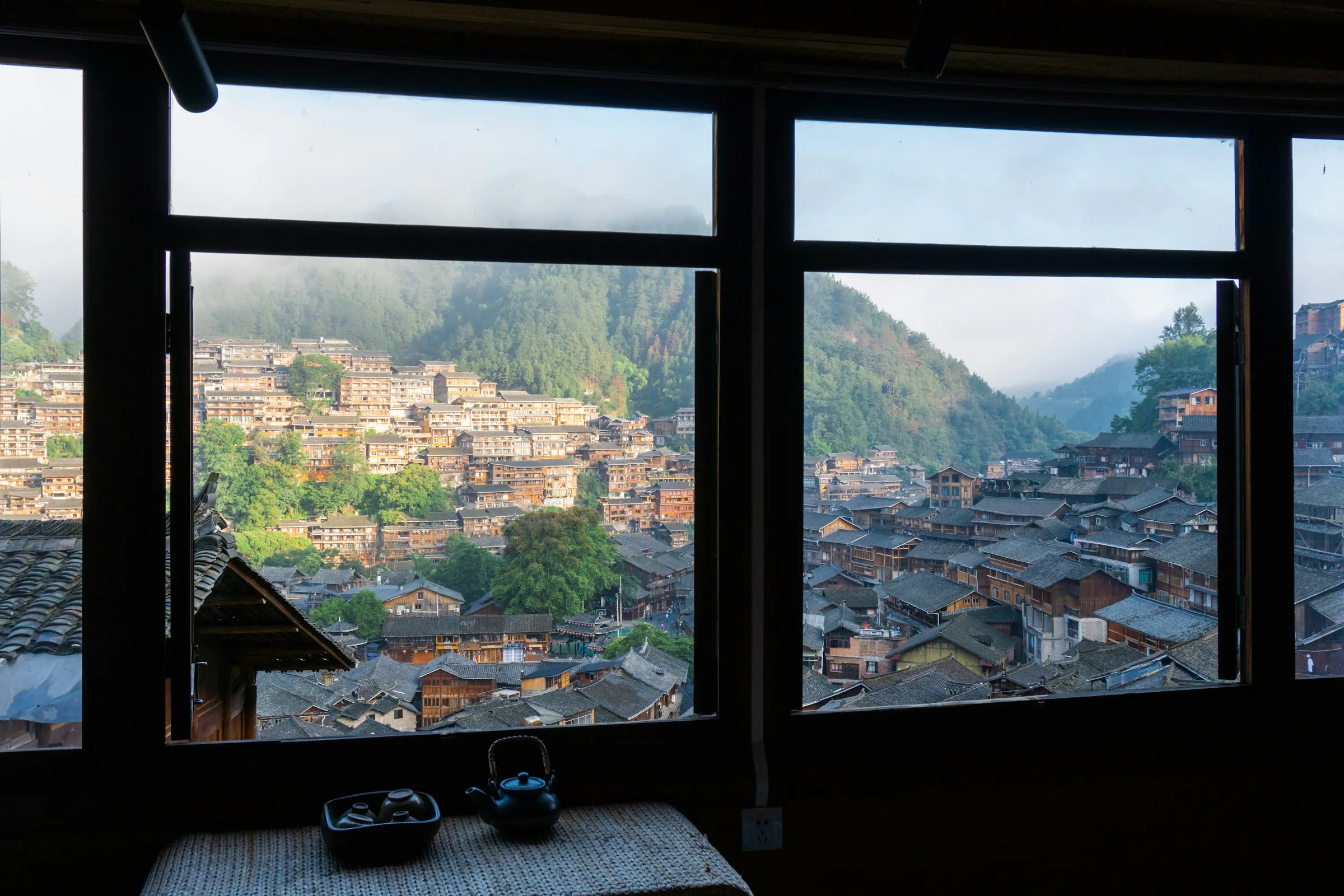
Shiqiao village sits in the hills outside Danzhai county in southeastern Guizhou, on a ridge above the Qingshui River. Pan's family is Miao, and the workshop they keep here is the seventh generation under one roof, by their count. The papermaking is older than the building. The indigo is older than the papermaking. What we have come to sit with is a slow braid of the two crafts together, dyed sheet by dyed sheet, in a courtyard that has been doing this work since before anyone now living can remember.
The paper begins with the inner bark of the gou tree, what botanists call Broussonetia papyrifera, paper mulberry. Pan's cousin Wei walks us out behind the workshop to show us the strips drying on a bamboo rack, pale yellow and stiff as bone. The trees are cut in winter from a stand the family tends along the river. The outer bark is shaved off; the inner layer is steamed, soaked in lime water for two weeks, washed in the river, and then beaten on a stone slab with a wooden mallet until the fibres separate into something that looks, in water, like a slow snowfall.
The vat for the pulp sits in a low brick basin in the courtyard's north corner, lined with a sheet of black plastic that is, Pan says without apology, the one modern concession her grandfather permitted. Before the plastic, the basin leaked every spring and the work began again. The pulp inside is cream-coloured, almost milky, and Wei shows us how it thickens slightly when the air cools toward evening. The dipping screen is a frame strung with bamboo splints so fine they read as a single surface. Pan lowers it into the vat at an angle we cannot replicate, lifts it with a small flick that throws excess water back into the basin, and a sheet of wet paper appears on the frame as if it had been there all along.
“The indigo vat is in a separate shed, set apart from the pulp because the two chemistries argue.”
The indigo vat is in a separate shed, set apart from the pulp because the two chemistries argue. The dye is rendered from the leaves of Strobilanthes cusia, the shrub the Miao here call ma lan, fermented with a rice-husk ash that pushes the pH higher and gives the blue a slightly cooler register than the dye yards we have seen further west. Pan's father, who is seventy-four, manages the vat. He does not measure. He smells it in the morning and adds what it wants. When we ask him how he learned, he says his mother used to make him stand at the rim as a child and inhale, and that the right vat smells like wet hay and the wrong vat smells like a sick animal. He has not yet, in his lifetime, kept a sick animal.
The dyeing is what makes the paper Miao. After a sheet has dried on the limewashed wall of the courtyard — pressed flat by hand, no machine — it is dipped whole into the indigo, lifted, oxidised in the air for several minutes, then dipped again. Pan dips one for us, and we watch the same green-to-blue arrival we have watched in dye yards elsewhere, only on a surface stiff enough to hold its own weight. The colour does not soak through evenly. It catches in the fibres where the bark beat slightly harder and leaves the thinner places paler, so each sheet finishes with a faint topography of blue, deeper here, washed there, the record of the mallet's day.
We had assumed, before arriving, that this would be a paper for collectors and for export. It is not, or not only. Pan walks us into a small back room where stacks of finished sheets are sorted by purpose. The thinnest, almost translucent indigo sheets are for the lusheng festival in lunar November, when the village cuts them into the long banners and standing flags that mark the dance ground. A heavier weight, dyed twice, becomes the paper used for the funeral umbrellas the family makes for neighbours — paper laid over a bamboo frame and oiled with tung, large enough to shelter the soul on its walk. Another stack, unstained, is sold to a calligrapher in Kaili who buys forty sheets a year and has done so since 1998.
Then she shows us the cut-paper work. Her aunt, Pan Xiulan, who lives two doors down and joins us mid-morning with a small pair of scissors and a board, cuts the indigo paper into the patterns that will be pasted onto the wooden granary doors at New Year — fish, butterflies, the eight-petalled flower that marks a household with an unmarried daughter. Xiulan cuts without a stencil. The scissors move the way her sister's hammer moved at the silversmith's workshop down the valley, in short doubled rhythms with pauses. A butterfly takes her perhaps four minutes. She gives one to us, still warm from her hand, and waves off the suggestion that we pay for it.
We sit with Pan through the early afternoon while she dips and her father feeds the vat. A neighbour comes in with a bucket of river water for the pulp basin. The dog moves twice, looking for shade. Pan tells us that the collective has four standing orders this year — two from temples in Guiyang, one from a Hong Kong gallery, one from a French paper conservator who buys six sheets a year for restoration work on Asian manuscripts — and that the festival paper, which is the largest share of the year's output, is not for sale at all. It is given. The village uses what it makes, and what is left after the giving goes to the orders.
By the time we leave, a sheet Pan dipped while we were drinking the first thermos is hanging from a beam above the courtyard, the blue still settling. The light has moved across it and made the topography legible — a darker band where the mallet had been heavier, a paler patch near one corner. The cousins are washing screens at the basin. Pan's father has gone back into the indigo shed to check the smell. The hammering from the silversmith's workshop, half a valley over, has started up again, three quick strikes and a pause, and the paper above us is still very slightly wet.
— ArtoEast
We design residencies, faculty-led programmes, and curated delegations around exactly this kind of work.
For universities, museums, cultural institutions, and other groups serious about understanding China at the level the essay above describes.
Programmes are designed bespoke. Tell us who is coming and what they are hoping to understand — we propose from there.
Start a conversation