ArtoEast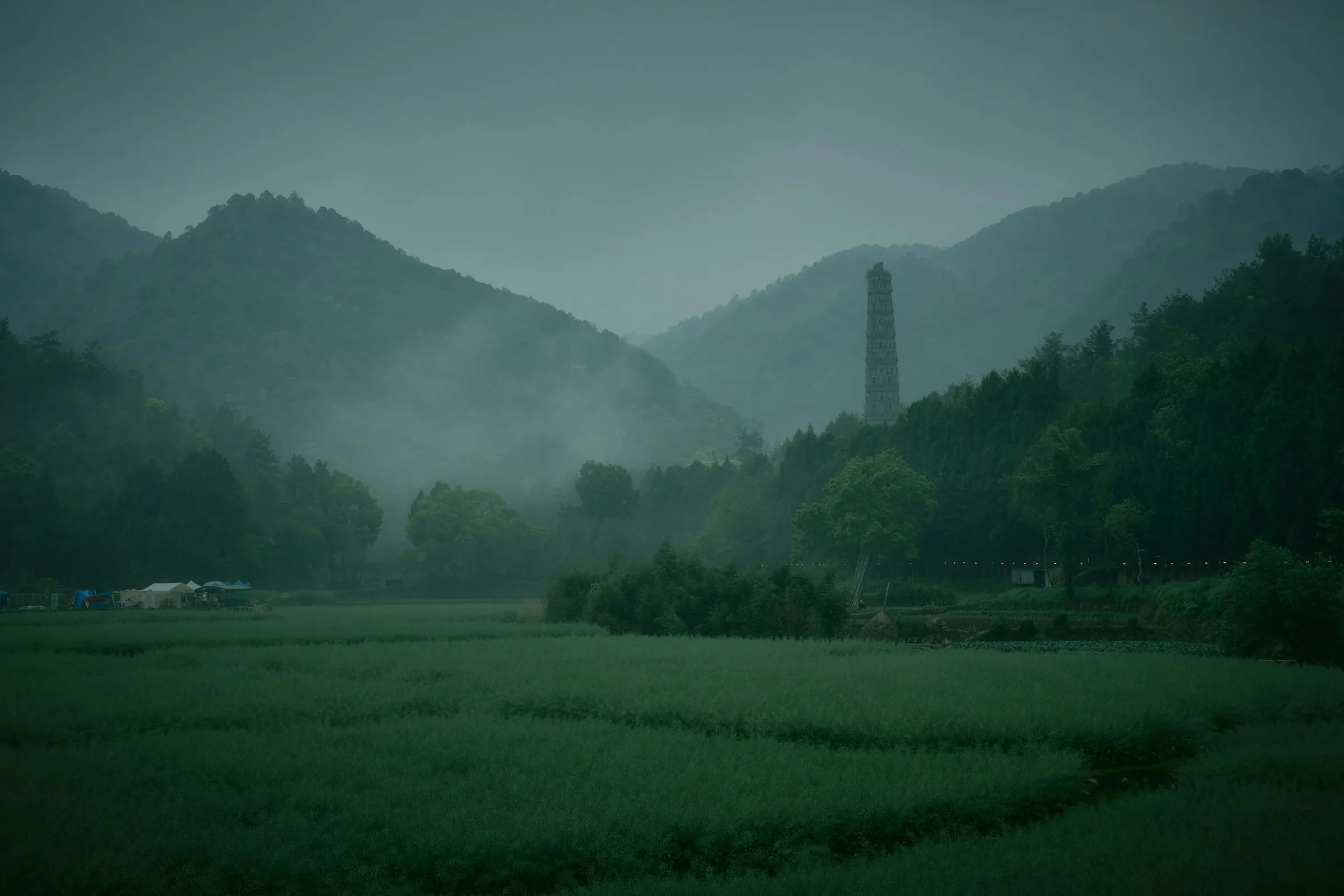
A Kaiping diaolou, and the village that left
In Zili, Guangdong, we sit beneath a 1920s watchtower built with remittance money from California laundries and Vancouver canneries, and consider what stayed behind.
We arrive in Zili village a little after eight in the morning, when the lotus pond at the foot of Mingshi Lou is still holding mist. The tower is fifteen stories of reinforced concrete, finished in 1925, and from the path it looks like someone in Kaiping ordered a Tuscan campanile by mail and then asked the mason to add a Moorish dome at the top, because why not. Damp brick smells rise off the lower courses. A grey cat watches from a stone threshold. Mr. Fang, who keeps the keys, is sweeping the forecourt with a bamboo broom and does not look up as we approach.
There are 1,833 diaolou still standing across Kaiping county, according to the cultural bureau's last count. UNESCO listed a selection of them in 2007, which is why the path here is paved and the signage is trilingual, but Zili itself remains a working village of perhaps forty households, most of them elderly. The rice paddies beyond the pond are tended by a cooperative now. We walk the lane between two of the smaller towers and Mr. Fang catches up, jingling a ring of iron keys the length of his forearm. He is seventy-one. His grandfather built the tower we are about to enter, using money wired home from a laundry on Stockton Street in San Francisco.
The ground floor is cool and dim, the walls nearly a meter thick. Mr. Fang points to the gun slits cut into the corners at chest height, angled downward. The towers were not built for beauty. They were built because the village had become wealthy in absentia, and wealth in absentia is the kind that gets robbed. In the 1910s and 1920s, bandits worked the Pearl River Delta in organized companies, and Kaiping, with its remittance income from the Gold Mountain men, was a known target. Families pooled silver dollars and commissioned the towers as fortified residences, refuge for the women and children when the men were overseas and the bandits came up the river.
We climb a narrow concrete stair, each tread worn into a soft dish. On the third floor, a parlor: a carved blackwood altar, a wind-up Seth Thomas mantel clock from Connecticut, a framed photograph of a young man in a high collar, taken in a studio on Dupont Street around 1919. Mr. Fang says the young man is his great-uncle, who sent back the money for the clock and the altar and most of the fourth floor. He never returned. He is buried in Colma, California, in a cemetery Mr. Fang has seen only on his nephew's phone.
The eclectic style of the diaolou has been written about as a kind of architectural pidgin, and that is fair as far as it goes. The builders were Cantonese village masons working from postcards, magazine clippings, and the verbal descriptions of returnees. A Romanesque arcade here, a Corinthian capital there, a Cantonese tiled eave below a vaguely Iberian cupola. What the photographs do not convey is how careful the proportions are. Whoever drew the elevations understood weight. The towers do not look pasted together up close. They look considered, the way a letter home is considered when postage is expensive and the writer has only one sheet of paper.
“The towers were not built for beauty. They were built because the village had become wealthy in absentia, and wealth in absentia is the kind that gets robbed.”
On the fourth floor we find the ancestral register, kept in a camphor chest. Mr. Fang lifts out a stack of bound ledgers and sets them on a table by the window. The pages are ruled by hand, names entered in two columns: the village name on the left, the overseas name on the right, sometimes anglicized, sometimes a phonetic guess. Lee Wing Kee, San Francisco, 1908. Chan Bak Lim, Vancouver, 1913. Wong Sou Fan, Havana, 1921. Beside each name, in a different hand and a later ink, the date the remittances stopped. For many it is 1941 or 1942, when the Pacific war broke the postal routes. For some it is simply a blank, and a small drawn circle, which Mr. Fang says means the family lost track.
He shows us the WeChat group on his phone. It has 312 members. Most of them live in Burlingame, Daly City, Richmond BC, and a cluster in Lima, Peru. They are the great-grandchildren of the men in the register, and they have spent the last decade reconstructing the columns. Someone in Vancouver photographs a tombstone in Mountain View Cemetery; someone in Zili matches it to a ledger entry; the circle is closed. A woman in Burlingame, a dental hygienist, has visited four times since 2018. She paid to have the roof of her family's tower re-waterproofed last spring.
We step out onto the roof terrace. From here the Tan River is a thin grey ribbon and the paddies are laid out in the geometry of an old quilt. Mr. Fang points east, to a low ridge, and says that in 1944 a Japanese reconnaissance plane circled this tower twice before turning back toward Guangzhou. His mother, then nine, was inside with the other children. She remembered the sound of the engine more than the fear. She is still alive, in Jiangmen, and she has never climbed the tower since.
The lotus pond below is fed by a stone channel that runs under the lane. In summer the flowers are pink and the leaves shed water in beads the size of marbles; today, in early winter, the pads are brown and folded and the water is the color of weak tea. A pair of white ducks works the edge. Mr. Fang says the pond is older than the tower by perhaps three hundred years, and that the geomancer who sited the tower insisted it be built so the lotus pond fell within the protective arc of the front wall. Whether this worked against bandits is unclear. It seems to have worked against time.
Before we leave he takes us to the ancestral hall, a low building with a black-tiled roof at the village entrance. The hall is being slowly restored with money from the WeChat group and a matching grant from the county. The carpenters are working in dialect we don't follow, a Toisanese that even standard Cantonese speakers find slippery. A new beam is being fitted to replace one that termites took in the nineties. The wood is camphor, sourced from a yard in Guangzhou, and the smell when the plane runs over it is sharp and clean and makes the dim hall feel suddenly inhabited.
We sit for a while on the bench outside, watching Mr. Fang lock up. He will do this again tomorrow morning, and the morning after. The towers will continue to settle into their foundations at the rate of perhaps a millimeter a decade. The names in the ledger will keep being matched, one by one, to graves in California and British Columbia and the outskirts of Havana. The village that left is, in some slow and partial way, returning, not as bodies but as repaired roofs, photographed headstones, restored beams. We walk back down the lane in the late morning light, past the lotus pond, and do not say much.
Practical notes for a visit: Zili is roughly two hours by car from Guangzhou South railway station. The site opens at 8:30; arriving at opening is the only way to have the towers to yourself for an hour. Mr. Fang's name has been changed here; the caretaker on duty rotates among several village families. If you have Cantonese, he will tell you more than the signage does. If you have a family name from the Sze Yup counties — Toisan, Hoiping, Yanping, Sunwui — bring it. The registers are open to anyone willing to sit with them.
— ArtoEast
Photography by 一只猫的橘 via Unsplash.
We design residencies, faculty-led programmes, and curated delegations around exactly this kind of work.
For universities, museums, cultural institutions, and other groups serious about understanding China at the level the essay above describes.
Programmes are designed bespoke. Tell us who is coming and what they are hoping to understand — we propose from there.
Start a conversation